
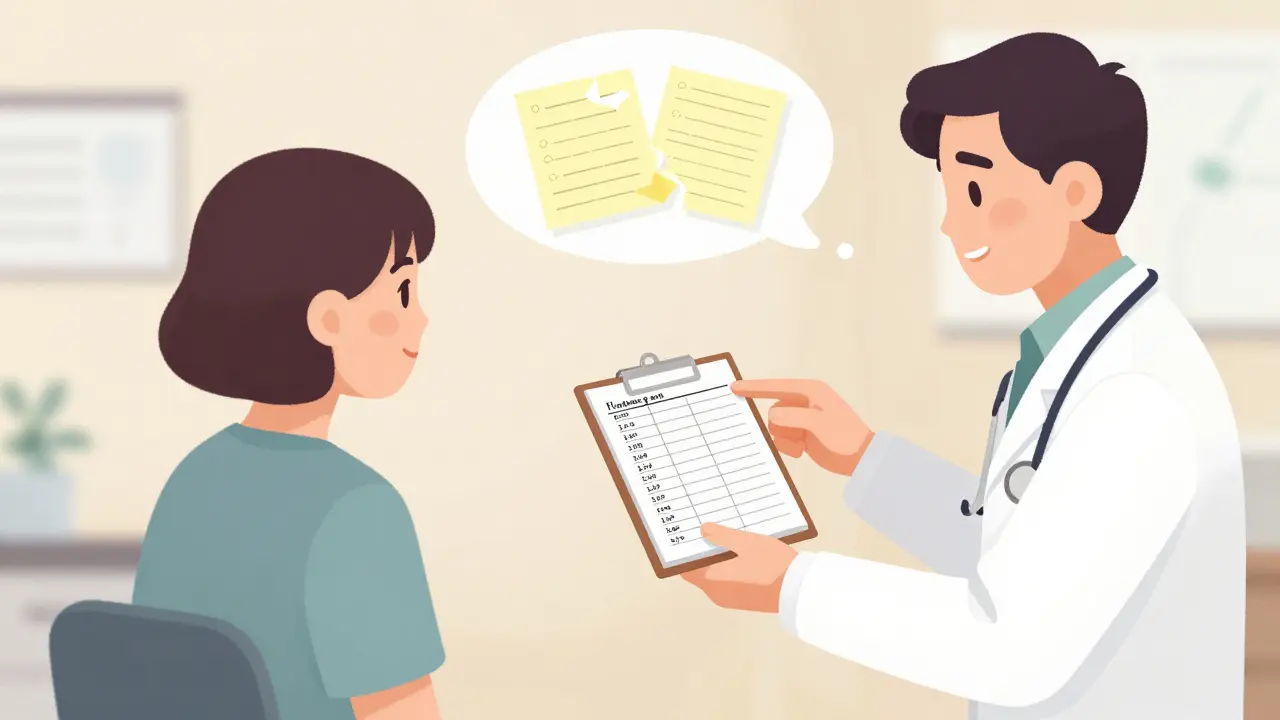
When your doctor or pharmacist gives you advice about a new medication, it’s easy to think, "I’ll remember this." But in the rush of a clinic visit, with questions about side effects, timing, and food interactions, details slip away. By the time you get home, you’re wondering: Did they say take it with food or on an empty stomach? How many refills are left? What should I do if I miss a dose? That’s why writing down provider advice about medications isn’t just helpful-it’s essential.
Why Documentation Matters
Every year, about 7,000 people in the U.S. die from medication errors, according to the Institute of Medicine. Many of these aren’t caused by bad drugs or wrong doses-they’re caused by miscommunication and poor documentation. When you or your provider doesn’t clearly record what was said, someone else-like a pharmacist, nurse, or even another doctor-might make a dangerous assumption. Good documentation protects you. It ensures that if you switch doctors, go to the ER, or need a refill, everyone has the same accurate picture. It also protects your provider. If a legal question comes up later, a well-documented conversation is proof that you were informed and agreed to the plan.What to Write Down
Don’t just jot down the drug name. You need the full picture. Here’s exactly what to capture:- Medication name (brand and generic, if different)
- Dosage (e.g., 10 mg, 500 mg)
- Frequency (e.g., "once daily," "every 6 hours as needed")
- Timing (e.g., "with breakfast," "at bedtime," "on an empty stomach")
- Duration (e.g., "for 14 days," "until refill," "long-term")
- Number of refills (and when the next one is due)
- Purpose (why you’re taking it-e.g., "for blood pressure," "for pain after surgery")
- Side effects to watch for (especially serious ones like dizziness, rash, or trouble breathing)
- Interactions (foods, alcohol, other meds to avoid)
- What to do if you miss a dose
- When to call the provider (e.g., "call if you feel faint for more than 2 days")
- Any refusals or concerns you expressed (e.g., "Patient said she’s afraid of weight gain, so we discussed alternatives")
Don’t leave out the small stuff. A simple note like "Provider advised not to drink grapefruit juice" can prevent a dangerous reaction later.
How to Record It
You have options. Choose the one that works best for you.Use your phone: Open the Notes app or voice memo. Record the conversation right after the visit. Say the medication name, dosage, and instructions out loud. Later, transcribe it into a text note. This is faster than writing and reduces errors.
Use a printed form: Many clinics give patients a medication list at discharge. If not, print one from your provider’s patient portal. Fill it in during the visit. Keep a copy in your wallet or purse.
Use a medication tracker app: Apps like Medisafe, MyTherapy, or even Google Keep let you set reminders and log instructions. Some sync with your pharmacy and send alerts if a refill is due.
Write it by hand: If you prefer pen and paper, use a dedicated notebook. Label each entry with the date and provider’s name. Keep it in a consistent place-like your medicine cabinet or a binder.
Whatever method you choose, make sure it’s accessible. If you’re caring for someone else, make sure they can find it too.
What Your Provider Should Document
Your provider has legal and professional obligations to document medication advice. According to the American Medical Association and the Joint Commission, records must include:- Clear, dated entries with the provider’s initials or electronic signature
- All medication changes, including new prescriptions, dose adjustments, or discontinuations
- Any patient education given-whether it was verbal, written, or shown via video
- Medication allergies and reactions, with details (e.g., "rash after amoxicillin, 2021")
- Refusals or noncompliance, including reasons given by the patient
- Medication reconciliation at every transition of care (e.g., hospital to home, ER to clinic)
Providers are required to document not just what was prescribed, but what was discussed. If you asked about cost, and they suggested a generic, that’s part of the record. If you said you couldn’t afford it, and they arranged a sample or coupon, that needs to be written down too.
Electronic Health Records (EHRs) and Patient Portals
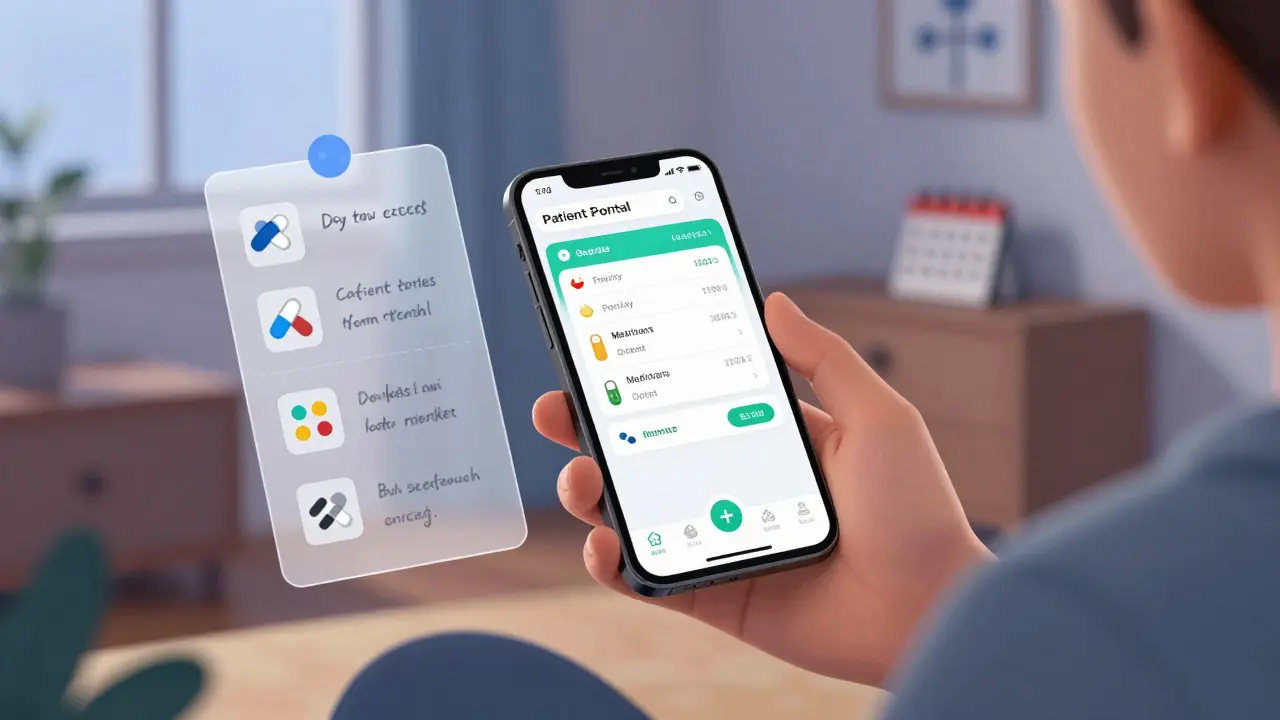
By 2026, 95% of medication documentation will happen through electronic health records (EHRs), according to the Agency for Healthcare Research and Quality. Most providers now use EHRs that auto-generate medication lists, refill requests, and alerts for interactions.But here’s the catch: just because it’s in the system doesn’t mean you’ve seen it. That’s why you need to check your patient portal regularly. Log in weekly. Look for:
- New prescriptions added
- Changes to dosage or frequency
- Refill status
- Messages from your provider about your meds
If something looks wrong-like a wrong dose or a drug you didn’t ask for-call right away. Don’t wait. EHRs aren’t perfect. Human error still happens during data entry.
What to Do If You’re Not Sure
If you leave the office confused, don’t pretend you understand. Go back to the basics:- Call the pharmacy. Pharmacists are trained to explain prescriptions. Ask: "Can you confirm the instructions for this med?"
- Check your portal. Many pharmacies now send digital instructions with your prescription.
- Send a secure message through your provider’s portal. Write: "Can you please clarify the instructions for [medication]? I’m unsure if I should take it with food. Thank you."
- Don’t guess. Taking a pill wrong can be dangerous. A 2020 NCQA report found that 22% of preventable drug events in outpatient care came from unclear instructions.
Keep It Updated
Your medication list isn’t a one-time task. It changes every time:- You get a new prescription
- You stop taking something
- You switch pharmacies
- You see a new provider
Update your notes immediately after each visit. If you’re seeing multiple doctors, bring your updated list to every appointment. It saves time and prevents dangerous overlaps.
Also, review your list every 3 months. Are you still taking all these meds? Are any no longer needed? Ask your provider during your next checkup.
Legal and Safety Implications
Inadequate documentation isn’t just inconvenient-it’s risky. A 2022 analysis by the Physician Insurers Association of America found that 38% of medical malpractice claims involving medications were due to poor documentation. That means if something goes wrong and you didn’t document the advice you received, you might not have proof that you were properly informed.Providers are held to the same standard. The American Dental Association warns: "What you write in the record could be read aloud in a court of law." That applies to every specialty. Your notes are legal documents.
For Medicare and Medicaid patients, CMS requires that every encounter include a current medication list. If it’s missing, the provider can’t get paid. That’s why they’re now more diligent-but you still need to verify.
Final Checklist
Before you leave the office, ask yourself:- Did I write down the full name, dose, and frequency of each new med?
- Did I note any food, drink, or activity restrictions?
- Did I record what side effects to watch for?
- Did I write down how many refills I have?
- Did I note any concerns I raised or questions I didn’t get answered?
- Did I check my patient portal to see if the record matches what was said?
If you answered "yes" to all of these, you’ve done your part. Now, make sure your family or caregiver knows where to find your list.
What should I do if I forget what my provider told me about my medication?
Call your pharmacy. Pharmacists are trained to explain prescriptions and can clarify dosage, timing, and interactions. You can also send a secure message through your provider’s patient portal. Never guess-taking a medication incorrectly can lead to serious side effects or reduced effectiveness.
Is it enough to rely on the pharmacy’s label?
The pharmacy label gives you the basics-name, dose, frequency-but it rarely includes all the context your provider gave. For example, it won’t say "avoid alcohol" or "take only if your blood pressure is above 140." Always cross-check the label with your own notes or your provider’s instructions.
Should I document advice given over the phone or during telehealth visits?
Yes. The American Dental Association and other professional groups now require documentation of all patient communications-including phone calls and telehealth visits. If your provider gave you new instructions remotely, write them down immediately after the call. Include the date and time.
How long should I keep medication documentation?
Keep your personal medication records for at least 7 years, or as long as you’re taking the medication. For chronic conditions, keep them indefinitely. Many states require providers to keep medical records for 7-10 years, but your personal copy is your best backup if records are lost or inaccessible.
Can I use a spreadsheet to track my medications?
Yes. A simple spreadsheet with columns for medication name, dose, frequency, purpose, refills, and notes is a great tool. Many people find it easier to update than paper lists. Just make sure it’s backed up and accessible to someone else in case of emergency.


13 Comments
Just started using Medisafe last month and it’s been a game-changer. Set reminders for my blood pressure med, and it even alerts me when refills are due. No more guessing if I took it or not. Also, my mom can see my list now-huge relief for her.
Simple, clean, and actually works. Try it.
Man i totally forgot to write down the grapefruit juice thing and ended up in the er last month. My bp spiked like crazy. Doc said i was lucky i didnt have a stroke. Now i keep a notebook next to my pillbox. Even if i think i remember. I dont.
stupid easy thing to do. why dont more people do it?
Documentation isn't merely a bureaucratic formality-it's an ethical imperative, a hermeneutic act of self-preservation; in the labyrinth of pharmaceutical complexity, the written word becomes our anchor, our ontological bulwark against the chaos of cognitive overload, the tyranny of transient memory, and the silent violence of institutional negligence.
Every scribbled note is a quiet rebellion against the commodification of care, a reclamation of agency in a system designed to render us passive recipients.
And yet-how many of us, in our exhaustion, reduce this sacred act to a checkbox?
Our bodies remember what our minds forget-and yet, the system demands we remember for it.
Is it not a profound irony that the very tools meant to heal-prescriptions, charts, portals-require us to become archivists of our own vulnerability?
Perhaps the real medication isn't in the bottle, but in the discipline of writing it down.
Not for the provider.
Not for the pharmacist.
But for the version of ourselves that will wake up confused, afraid, and alone-again.
Write it down.
Write it down.
Write it down.
And when you do-you’re not just recording a dose.
You’re affirming your right to exist, clearly, safely, and without apology, in a world that would rather you forget.
THIS. THIS. THIS. I’ve been telling my patients this for years and nobody listens until someone ends up in the ER.
My aunt took her blood thinner with grapefruit juice and almost died. She didn’t write anything down. Thought she ‘knew’ it.
Don’t be her. Grab your phone. Record it. Send it to yourself. Print it. Stick it on the fridge.
You’re not being paranoid-you’re being smart. And if you’re helping someone else? Make sure THEY know where the list is.
It’s not extra work-it’s life insurance.
I really like the idea of using a spreadsheet. I made one last year with all my meds, refills, side effects, and even notes like 'doc said avoid caffeine after 2pm' and 'pharmacist said this interacts with my fish oil'.
It’s color-coded now-green for active, red for discontinued. I even added the pharmacy phone number and provider’s email.
It’s saved me so many times. I share it with my sister, and she says it’s the first thing she checks when I’m sick.
Also, I print a copy and keep it in my wallet. Just in case.
As someone who’s worked in community health for over 20 years, I’ve seen firsthand how documentation gaps lead to preventable harm-especially among elderly patients, non-native speakers, and those managing multiple conditions.
But here’s what’s missing from most advice: accessibility.
Not everyone has a smartphone. Not everyone reads well. Not everyone has reliable internet.
So while apps and portals are great, we must also normalize printed, large-font, multilingual handouts-and train providers to give them without being asked.
Also: include a simple diagram. A little clock with pills and arrows for morning/evening? Game-changer.
Documentation isn’t just about accuracy-it’s about equity.
Let’s make sure no one’s left behind because they can’t tap an app.
OMG I love this so much!! I’ve been doing this since my mom had that bad reaction to her statin and I realized I had NO IDEA what she was on.
Now I have a whole binder-color-coded tabs, laminated pages, even a QR code that links to a video I recorded explaining everything.
My cousins think I’m extra but when my uncle had the stroke last year, the nurses were like ‘how did you have all this info??’
It’s not OCD, it’s love.
Also, I printed it on recycled paper because I’m eco-conscious.
And I use a gel pen because it doesn’t smudge.
And I have a backup cloud copy and a USB stick in my drawer and my sister has a copy too.
And I label everything with emojis.
Because joy matters.
Let me tell you something the medical-industrial complex doesn't want you to know: EHRs are not secure. They are surveillance tools. Every time you log into your portal, your data is sold to pharmaceutical corporations who then target you with ads for drugs you don't need.
And the 'medication tracker apps'? Most are owned by Big Pharma subsidiaries.
They want you to think you're in control-but you're just feeding them data.
The only safe way? Pen and paper. Locked in a drawer. No Wi-Fi. No cloud. No algorithms.
And if your doctor pushes digital? Say no. They are not your friend.
They are profit-driven agents of a system that profits from your confusion.
Write it down. Burn the digital trail.
Survival is not optional.
Ugh. I’m so tired of Americans acting like they invented patient empowerment. In Canada, we’ve had standardized medication lists since the 90s. We don’t need a blog post to tell us to write things down-we just do it.
And our pharmacists? They actually call you if something’s wrong.
Meanwhile, you’re all over here recording voice memos like it’s a TikTok trend.
It’s not ‘innovative’-it’s a failure of public health infrastructure.
But hey, at least you’ve got a cute notebook.
Let’s be clear: this entire paradigm is a distraction. The real issue isn’t poor documentation-it’s polypharmacy. The system intentionally overprescribes. Then, when the side effects manifest, they blame the patient for not ‘adhering’ to instructions.
My grandfather was on 17 medications. He didn’t forget-he was poisoned by protocol.
Documentation doesn’t fix systemic iatrogenesis.
It just makes you feel better while the machine keeps grinding.
Stop documenting the symptoms. Start questioning the prescriptions.
And if you’re still taking that statin? You’re being manipulated.
Ask for the trial data.
Ask for the profit margins.
Then burn the list.
Okay but why is this even a thing? Like why do we have to be our own medical secretaries? Shouldn’t the system just work? Why am I responsible for remembering every tiny detail when the doctor’s office can’t even send me a text?
It’s exhausting. And honestly? Kinda humiliating.
Also, I tried the app. It sent me 12 notifications a day. I deleted it.
Now I just hope I don’t die because I forgot if I took my pill or not.
Thanks, capitalism.
The act of documenting medical advice transcends mere practicality; it is an expression of self-respect and an assertion of dignity within a healthcare system that often reduces patients to data points. The precision with which one records dosage, timing, and contraindications reflects not only diligence, but a quiet, unspoken commitment to one’s own well-being.
It is a form of resistance-not loud, not performative, but steadfast.
And while technology offers tools, the human hand, the ink on paper, remains the most enduring medium of truth.
One does not document to please the provider.
One documents to honor the self.
Just called my pharmacy and they read me back my entire med list-corrected a wrong dose I didn’t even notice. They were super nice. No judgment. Just helped.
Don’t overthink it. Call them. They’re there for this.