

Before 2012, waiting for a generic drug to hit the market could take years. Backlogs piled up. Applications sat untouched. Patients waited longer for affordable meds. That changed with the Generic Drug User Fee Amendments - or GDUFA. It wasn’t just a policy tweak. It was a reset. A financial lifeline for the FDA’s generic drug review system, funded by the very companies making those low-cost pills. Today, GDUFA is the backbone of how America gets safe, affordable generics on shelves fast.
What GDUFA Actually Does
GDUFA lets the FDA collect fees from generic drug makers to pay for reviewing their applications. Before GDUFA, the agency relied mostly on Congress for funding - and that money wasn’t enough. Applications piled up. Review times stretched to over 30 months. By 2012, more than 1,000 applications were stuck in limbo. GDUFA fixed that by giving the FDA a steady stream of cash, tied directly to the work it needed to do.
The law requires generic drug companies to pay fees for:
- Each Abbreviated New Drug Application (ANDA) they submit
- Each change they ask for after approval (called a Prior Approval Supplement)
- Each Drug Master File (DMF) they reference
- Every manufacturing facility - domestic or foreign - that makes their drugs
These aren’t taxes. They’re user fees. By law, the FDA must spend every dollar on generic drug review: inspections, staff salaries, tech upgrades, and application assessments. No mixing with other programs. No diverting to unrelated work. That’s the deal.
Why Foreign Facilities Pay More
If you make generic drugs in India, China, or elsewhere, you pay more than a U.S.-based company. Why? Because inspecting overseas factories is harder, costlier, and takes longer. GDUFA I, launched in 2012, added a $15,000 surcharge on foreign facilities - whether they made the active ingredient (API) or the final pill (FDF). The FDA argued it reflected real inspection costs. Critics called it unfair.
But here’s the truth: over half of all U.S. generic drugs now come from foreign plants. India alone supplies nearly 40% of America’s generic prescriptions. So the fee isn’t just about cost - it’s about scale. The FDA needs to send inspectors across oceans, deal with language barriers, and verify compliance across different regulatory systems. That’s expensive. The surcharge helps cover it.
How GDUFA Changed the Game
Before GDUFA, the average review time for a generic drug application was 32 months. By 2017, under GDUFA I, that dropped to 10 months. By 2023, under GDUFA III, it was down to 8 months. That’s not a coincidence. It’s the result of funding.
The FDA hired hundreds of new reviewers. It built better software to track applications. It created a public dashboard showing real-time progress on every pending ANDA. Companies now know exactly when their drug will be reviewed - and when it might get approved. Predictability matters. It helps manufacturers plan production, manage inventory, and get drugs to patients faster.
And the backlog? Gone. In 2012, there were over 1,100 pending applications. By 2024, that number was under 50. That’s a 95% reduction. The FDA now clears over 90% of applications within its target timeline. That’s a win for patients, pharmacies, and insurers.
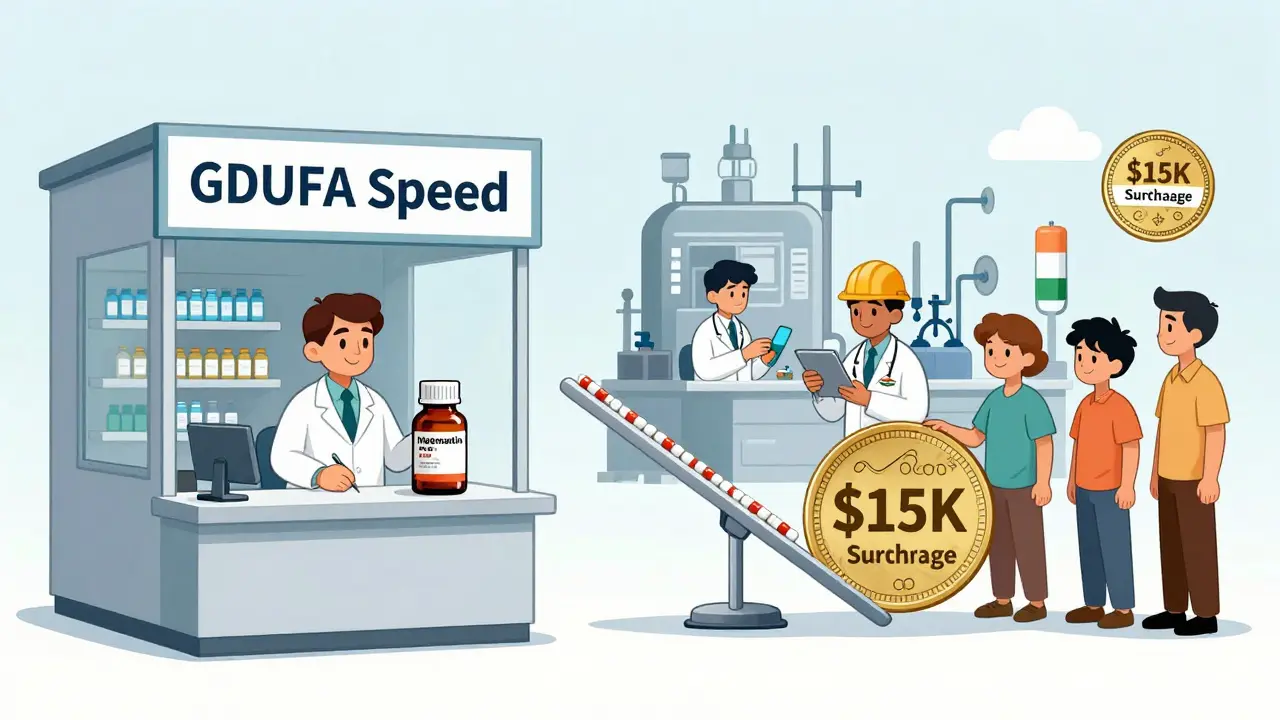
Who Pays - and Who Struggles
Large generic manufacturers like Teva, Mylan, and Sandoz can handle the fees. They have dozens of products. They spread the cost across many applications. But smaller companies? They feel the pinch.
Under GDUFA I, a small company with one drug and one foreign facility paid nearly $200,000 just to get started. That’s more than most startups could afford. So many didn’t even try. The market got more concentrated. The top 10 companies now control over half the U.S. generic market.
GDUFA II (2018) tried to fix that. It lowered fees for companies with fewer products. It introduced a “small business” discount for firms with under $1 million in annual generic sales. GDUFA III (2023) went further - adding a new Pre-ANDA Program that lets small companies meet with FDA scientists before filing. No fee. No pressure. Just guidance.
Still, the annual facility fee remains a hurdle. A small U.S.-based company with one product still pays $175,389 just to keep its facility on the list. That’s not a one-time cost. It’s every year. And if you’re not selling enough to cover it, you might just shut down.
What’s New in GDUFA III
GDUFA III, which runs through 2027, isn’t just about fees. It’s about smarter review. The FDA added:
- Pre-ANDA Program: Early meetings with FDA scientists to avoid costly mistakes
- ANDA Assessment Program: A faster track for simple, low-risk applications
- Controlled Correspondence: A formal way to ask questions and get written answers before filing
- Drug Master File Assessments: Pre-review of DMFs so they’re ready when needed
These aren’t buzzwords. They’re tools that cut months off review time. For complex generics - like inhalers, injectables, or topical creams - this is huge. Before, companies would submit an application, wait 6 months for feedback, then fix it and resubmit. Now, they get help early. That means fewer rejections. Fewer delays. More drugs on shelves.
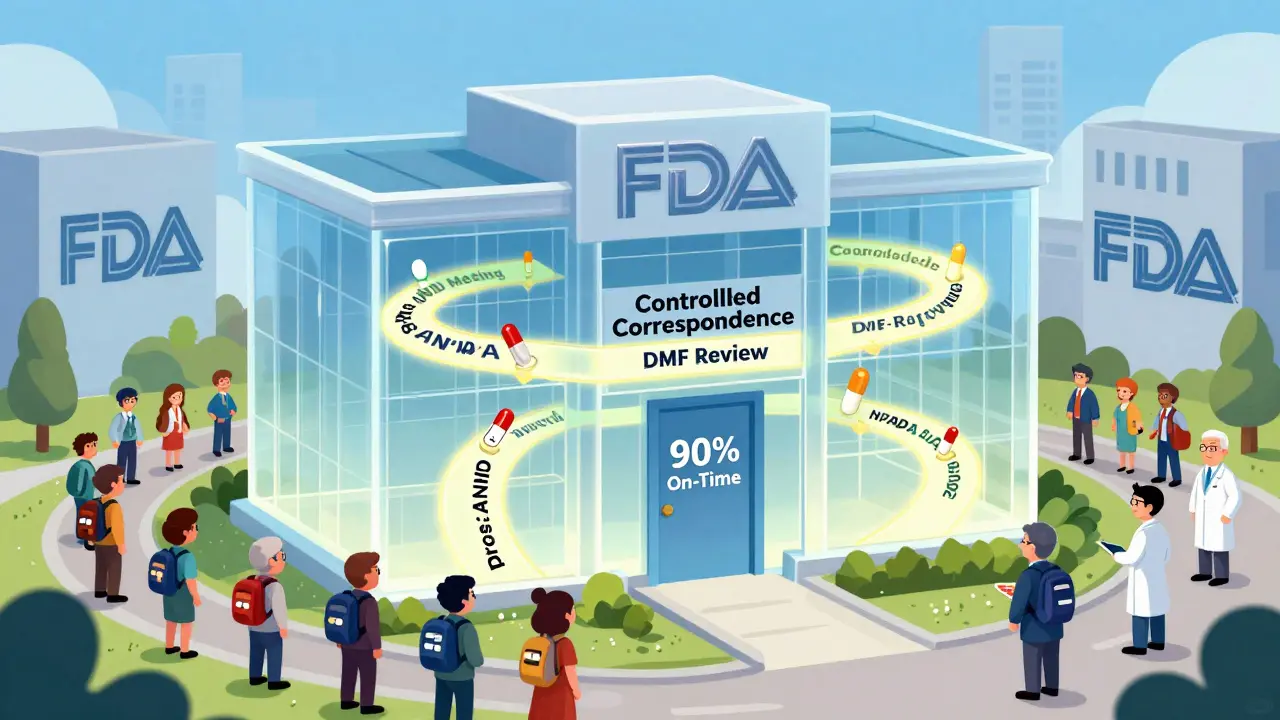
Transparency Is the New Standard
Under GDUFA I, the FDA didn’t publish much. No timelines. No progress reports. Just silence. GDUFA III changed that. Now, the agency posts monthly updates on:
- How many applications are pending
- How many were approved
- How many inspections were completed
- How many were missed
Anyone can see it. Patients. Competitors. Regulators. It’s a new level of accountability. If the FDA misses its own deadline, it has to explain why. That pressure keeps things moving.
The Bigger Picture
Generic drugs make up 90% of all prescriptions filled in the U.S. They save patients and the system billions every year. Without GDUFA, that number would be lower. Wait times would be longer. Prices would be higher.
The program isn’t perfect. Small companies still struggle. Foreign manufacturers still complain. But the data doesn’t lie: GDUFA works. It’s the reason you can buy metformin for $4 at Walmart. It’s why insulin generics are now available. It’s why the U.S. can keep drug costs from spiraling out of control.
The next reauthorization - GDUFA IV - will start in 2025. Stakeholders are already talking. Should fees be adjusted for inflation? Should there be more help for small businesses? Should digital submissions become mandatory? These are the questions ahead.
One thing’s clear: without GDUFA, the FDA couldn’t keep up. And without fast, reliable generic drug approvals, millions of Americans pay more - or go without.
What is GDUFA?
GDUFA stands for the Generic Drug User Fee Amendments. It’s a U.S. law that lets the FDA collect fees from generic drug manufacturers to fund the review of generic drug applications. These fees pay for staff, inspections, and systems that speed up approval times and ensure drug safety.
Who pays GDUFA fees?
Generic drug manufacturers pay GDUFA fees. This includes companies that make the active ingredient (API) and those that produce the final pill or injection (FDF). Both U.S. and foreign manufacturers pay, but foreign facilities pay an extra $15,000 per site due to higher inspection costs.
How often is GDUFA renewed?
GDUFA is renewed every five years by Congress. The first version (GDUFA I) started in 2012. GDUFA II ran from 2018 to 2022. GDUFA III began in October 2022 and runs through September 30, 2027. A new version, GDUFA IV, will be negotiated before 2027 to ensure the program continues.
Do GDUFA fees help lower drug prices?
Yes, indirectly. Faster approvals mean more generic drugs enter the market sooner. More competition drives prices down. Before GDUFA, delays kept generics off shelves for years. Now, with faster reviews, patients get affordable alternatives quicker - often within months instead of years.
Can small generic manufacturers afford GDUFA fees?
It’s difficult. The annual facility fee alone can exceed $175,000. GDUFA II and III introduced discounts for small businesses with under $1 million in generic sales, and the Pre-ANDA Program helps them avoid costly mistakes. But many still struggle, and some exit the market because the cost outweighs their sales volume.
How does GDUFA affect drug availability in the U.S.?
GDUFA directly improves drug availability. Since 2012, the FDA has approved over 2,000 new generic drugs. The backlog that once held up approvals has been eliminated. More generics mean more options, lower prices, and better access - especially for chronic conditions like diabetes, high blood pressure, and asthma.


8 Comments
So let me get this straight - we’re paying Indian factories MORE to make our cheap pills, but somehow that’s fair? Meanwhile, my insulin still costs $300 and the FDA’s got a shiny dashboard showing ‘approved’ like it’s a TikTok count. This isn’t reform, it’s corporate welfare with extra steps.
Foreign facility fee is justified. Inspection logistics across borders demand higher cost. FDA must ensure quality. Indian manufacturers understand this. No complaint. Only need faster review cycles. More transparency helps. Data speaks. Approval time down to 8 months. Good.
Let’s be real - GDUFA didn’t save patients, it saved Big Pharma’s bottom line. You think Teva gives a damn about your metformin? They care about the $200K they paid to get it approved so they can charge $12 instead of $8. And now they’re the only ones who can afford to play. This isn’t access, it’s consolidation dressed up as progress. The FDA’s dashboard is just a PR stunt. Real transparency would show how many small labs shut down because they couldn’t pay the annual fee. Spoiler: it’s not pretty.
And don’t get me started on ‘Pre-ANDA Program’ - that’s just fancy talk for ‘come beg us for advice before you go broke.’ You think a startup with $50K in savings gets a seat at that table? Nah. They get a form letter and a bill.
They call it ‘user fees’ like we’re at a spa. It’s a tax on competition. And now the market’s a monopoly with a spreadsheet.
It’s funny how we celebrate efficiency but ignore the human cost. GDUFA made generics faster - yes. But it also made them fewer. The system optimized for scale, not diversity. We traded a hundred small innovators for ten big ones who all make the same five drugs. And now when one factory in Hyderabad has a hiccup, the whole country feels it. We turned medicine into a supply chain problem and called it progress. Maybe the real question isn’t how fast we approve drugs - but how many kinds we’re willing to lose along the way.
The data clearly demonstrates that GDUFA has significantly improved public health outcomes through increased generic drug availability and reduced approval timelines. The program’s structured funding model ensures accountability, transparency, and regulatory rigor. It is a model of effective public-private collaboration that prioritizes patient access without compromising safety standards.
While the efficiency gains under GDUFA are undeniable, the financial burden on small manufacturers remains a critical systemic issue. The annual facility fee, even with partial relief measures, continues to act as a barrier to market entry. Without structural adjustments - such as tiered fee structures based on revenue or federal subsidies for qualifying small businesses - the program risks entrenching market concentration rather than fostering competition.
okay so i just read this whole thing and like… why does india pay more?? like i get the flying inspectors thing but like… its not like they’re making bad pills?? also why is the FDA allowed to just charge companies like its a vending machine?? and also i saw that one graph and it looked like 95% of the backlog is gone but like… who even knows if those drugs are safe??
Y’all are overthinking this. GDUFA works. The numbers don’t lie. 8 months to approve? That’s faster than getting a new iPhone. People whine about fees but they don’t see the $4 metformin on the shelf. Big Pharma? Nah. It’s the small guys who got crushed by the old system - no reviews, no timelines, no hope. GDUFA gave everyone a shot. Sure, it’s not perfect. But it’s the best damn thing that’s happened to generic drugs since aspirin. Stop crying about $200K and go make a pill.