
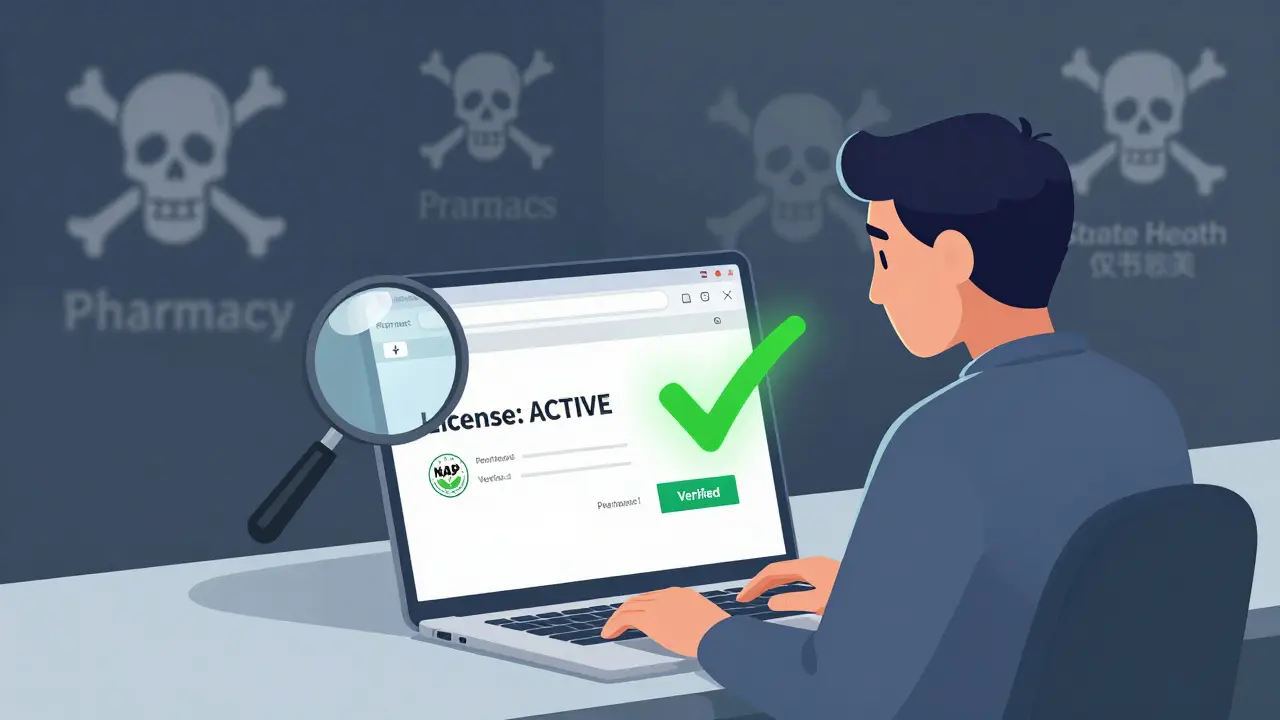
Buying medication online sounds convenient-until you realize how many fake pharmacies are out there. In 2022, the FDA shut down over 1,200 illegal online pharmacies selling counterfeit drugs. Some of these sites looked just like real ones, with professional designs and fake reviews. But they didn’t have valid licenses. That’s why checking an online pharmacy’s license isn’t just a good idea-it’s a necessity. This guide shows you exactly how to do it, step by step, using the tools that actually work.
Why You Can’t Trust Just Any Online Pharmacy
Not all online pharmacies are dangerous, but many are. Some sell expired pills. Others ship fake versions of popular drugs like Viagra, insulin, or blood pressure medication. These aren’t just ineffective-they can kill you. The FDA found that 80% of websites selling prescription drugs without a valid license were operating illegally. Even worse, many of these sites don’t even have a physical address. They disappear after a few months, leaving customers with no recourse. The only way to know if a pharmacy is legitimate is to verify its license. Every state in the U.S. has its own board of pharmacy that issues licenses. These aren’t just business permits-they’re legal authorizations to handle controlled substances. If a pharmacy doesn’t have one, it’s breaking the law. And if you buy from them, you’re putting your health at risk.How State Pharmacy Verification Systems Work
Each state runs its own online system to check pharmacy licenses. These are free, official tools run by state health departments. For example, Washington State uses a system called HELMS (Healthcare Enforcement and Licensing Management System). You don’t need to download anything. Just open your browser, go to the state’s health website, and search. The process is simple:- Go to your state’s Department of Health website (for Washington, it’s doh.wa.gov).
- Find the License Verification section. It’s often under "Professionals" or "Regulatory Services".
- Enter the pharmacy’s exact business name or its license number.
- Review the results. Look for the license status: Active means it’s good. Expired, Suspended, or Revoked means walk away.
- Check the expiration date. Licenses usually renew every one or two years. If it’s about to expire, ask the pharmacy to prove they’ve renewed.
The Problem with State Systems
State verification systems are free, but they’re not enough if you’re buying from a pharmacy in another state. Let’s say you live in Alabama but order from a pharmacy in California. You’d have to go to California’s website, search, then come back. If the pharmacy has licenses in five states? That’s five separate searches. On average, it takes 22.7 minutes to verify a pharmacy across five states. There’s another issue: delays. When a pharmacy renews its license, it can take up to 72 hours for the state system to update. So if you check on Monday and it says "Active," the license might have expired on Friday. You’d have no way of knowing. And not all states are equal. Only 32 states share data with the National Association of Boards of Pharmacy (NABP). That means if a pharmacy is licensed in a non-participating state, you can’t find it through any national system. You’re stuck digging through each state’s website manually.NABP Verify: The National Solution
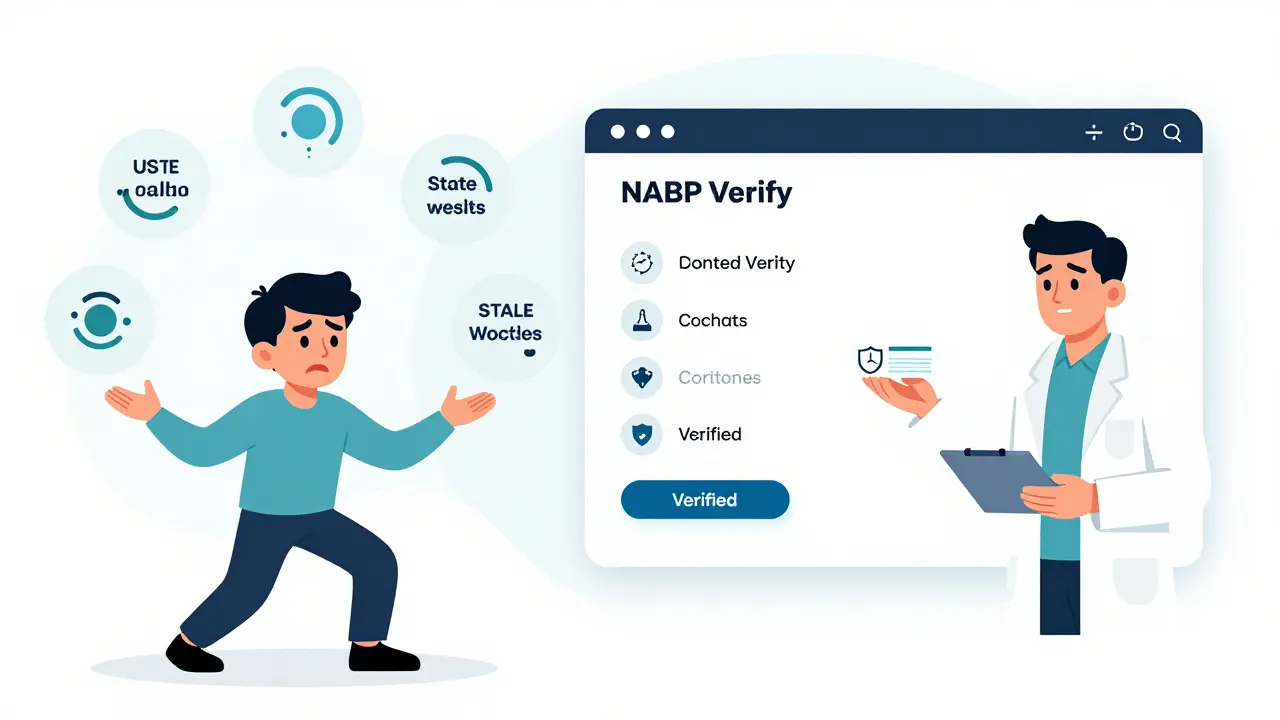
For pharmacies that ship across state lines, the best tool is NABP Verify. Launched in 2005, it’s the only system that checks licenses across all 50 states and territories in real time. It connects directly to 41 state boards, so updates happen within minutes-not days. Here’s how it works:- Go to nabp.pharmacy and click "Verify a Pharmacy".
- Search by name, address, or license number.
- See a live status: Active, Expired, Suspended, or Under Investigation.
- View disciplinary history, including past violations or complaints.
What to Look for When You Verify
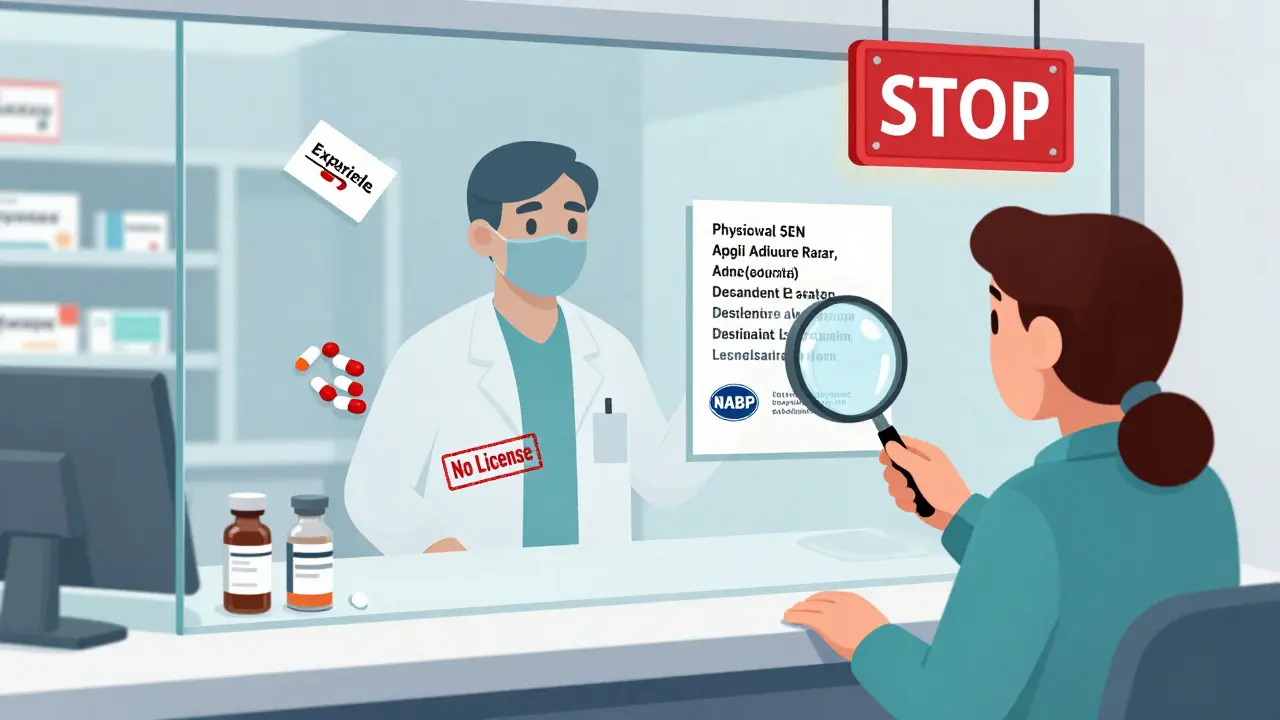
Once you find the license info, don’t just glance at it. Look for these red flags:- License status is "Inactive" or "Expired"-don’t buy.
- No physical address-only a P.O. box or virtual office? That’s a warning sign.
- No licensed pharmacist on staff-every pharmacy must have one. If the site doesn’t list a pharmacist’s name or license number, walk away.
- Prescribes without a prescription-if they sell controlled drugs without requiring a valid prescription, they’re breaking federal law.
- Prices are way too low-if a brand-name drug costs 70% less than at your local pharmacy, it’s likely fake.
What About Pharmacy Technicians?
Pharmacies aren’t just run by pharmacists. Pharmacy technicians handle prescriptions, fill bottles, and manage inventory. They need certification too. The Pharmacy Technician Certification Board (PTCB) verifies over 87,000 technicians every quarter. But here’s the problem: PTCB only checks technicians-not the pharmacy itself. So even if a pharmacy says "all our technicians are PTCB-certified," that doesn’t mean the pharmacy is licensed. You still need to verify the pharmacy’s license separately.How to Protect Yourself
Here’s what you should do before buying from any online pharmacy:- Check the pharmacy’s license on your state’s health website.
- If it ships nationwide, check NABP Verify for the seal.
- Look for a physical address and phone number you can call.
- Make sure they require a valid prescription from your doctor.
- Search online for complaints. Use Google with the pharmacy’s name + "scam" or "complaint".
What’s Changing in 2025
The system is getting better. Washington State is upgrading HELMS in late 2024 to allow API connections with electronic health records. That means your doctor’s system could automatically check a pharmacy’s license before sending a prescription. NABP is adding 14 more states to its real-time network by 2025. And the FDA is funding state upgrades with $15 million in grants. But until every state is connected, you still have to do the work yourself. Don’t assume someone else is checking for you.What to Do If You Find a Fake Pharmacy
If you find an unlicensed pharmacy, report it. You can file a complaint with:- The FDA’s MedWatch program (fda.gov/medwatch)
- Your state’s board of pharmacy
- The NABP’s Illegal Pharmacy Reporting Portal
How do I know if an online pharmacy is real?
Check its license on your state’s Department of Health website. Look for the license status-"Active" means it’s legitimate. Also, see if it displays the NABP Verified Internet Pharmacy Practice Sites (VIPPS) seal. Real pharmacies require a valid prescription and list a physical address and phone number.
Is NABP Verify free to use?
No, NABP Verify costs $79 per year. It’s designed for organizations like hospitals and insurers that verify multiple pharmacies. Individual consumers can check licenses for free through their state’s official website.
Can I trust pharmacies that ship from Canada?
Not necessarily. Canadian pharmacies must be licensed by Canadian authorities, but U.S. law still requires them to be licensed in the state where they ship. Many Canadian sites that sell to U.S. customers don’t have U.S. licenses. Always verify through your state’s system, even if the pharmacy claims to be "Canadian-approved."
What if the pharmacy’s license is expired?
Don’t buy from them. An expired license means the pharmacy is operating illegally. Even if they claim they’ve applied for renewal, they’re not authorized to dispense medication until the new license is active. Wait until they show proof of a current license.
Do all states have the same verification process?
No. Each state runs its own system. Some are easy to use, like Washington’s HELMS. Others require complex logins or don’t allow searches by name. Always use the official state website-never rely on third-party links.

15 Comments
Just spent 20 minutes verifying three pharmacies I buy from. One had an expired license. I called them. They said, 'Oh, we renewed last week.' No proof. I canceled the order. This guide saved me from a potential disaster. Don't trust 'verified' logos. Trust state databases. Period.
And yes, I know it's annoying. But so is ending up in the ER because your 'cheap' blood pressure meds are just sugar pills.
The state-by-state system is a bureaucratic nightmare. I work in healthcare IT. We built a tool that scrapes NABP and 41 state APIs in real-time for our network. The manual checks? They’re a relic. What’s wild is that most consumers don’t realize the FDA doesn’t regulate online pharmacies directly-it’s all state boards. That’s why NABP exists. $79 is a bargain if you’re verifying more than one pharmacy a month. For individuals? Use the state sites. But always cross-check with NABP’s public lookup. No cost, no login. Just type the name and go.
USA thinks it’s the only country with real pharmacy oversight. Funny. India has over 2 million licensed pharmacists. We regulate online sales through CDSCO and state drug controllers. No NABP needed. You don’t need a $79 subscription to know if your medicine is real. You need a government that actually works. Your system is broken because you outsource safety to private databases. We don’t pay for truth-we enforce it.
Did you know the FDA and NABP are in cahoots with Big Pharma? They push this 'verify your pharmacy' nonsense to scare people away from cheap Canadian meds. The real reason? Your local pharmacy pays $15,000/year to be in their system. Meanwhile, your insulin costs $400 because they control distribution. The 'NABP Seal' is a paid ad. The 'state license'? Often outdated. The truth? Most legitimate pharmacies operate offshore. They’re not illegal-they’re just not part of the cartel. Don’t be fooled by the 'active license' lie.
What is a license, really? A piece of paper signed by a bureaucrat who may or may not have verified the physical location. What is a seal? A logo designed by a marketing team. What is safety? A feeling we manufacture to feel in control. We don’t verify pharmacies-we verify our own fear. The real question isn’t whether the license is active-it’s whether we’ve surrendered our autonomy to systems we don’t understand. You think checking a website gives you power? You’re just scrolling through another cage. The pill doesn’t care if it came from a 'verified' site. It only cares if it works. And maybe, just maybe, that’s all that matters.
Why are we even talking about this? In the UK, we have the GPhC. Every pharmacy is listed. No nonsense. No $79 fees. No 72-hour delays. Just a public register. You type in the name. You see the address. You see the inspector’s notes. Done. Americans turn a simple safety check into a multi-step corporate odyssey. It’s not innovation. It’s incompetence dressed up as bureaucracy. Fix your system. Or stop pretending you care about public health.
Wait, so I’m supposed to pay $79 to check if a pharmacy is legit? That’s wild. I thought the whole point was to avoid paying for stuff. Now I gotta pay to avoid getting scammed? I’m all for safety, but this feels like a pyramid scheme where the top tier gets rich off our fear. Can’t we just have one national database? Like, I dunno, a .gov site? Not five different portals, not a paid API. Just… one. Simple. Free. Like a weather app. I’m not asking for much.
Oh honey. You think this is about safety? Nah. It’s about control. The state systems? They’re slow on purpose. NABP? They’re a nonprofit that somehow runs like a for-profit SaaS startup. And don’t get me started on how the 'NABP Seal' is basically a membership badge you buy like a LinkedIn premium. Meanwhile, real pharmacists? They’re overworked, underpaid, and stuck in a system designed to make them look like the enemy. You check a license. Great. But who’s checking the people who run the checks? That’s the real question. And no, I don’t have the answer. But I’m glad you’re asking.
Just tried HELMS. Took 12 seconds. Found the license. Active. But then I wondered-what if I’m not the one who needs to check? What if it’s the pharmacy’s job to prove they’re legit before you even get to the checkout? Why do we put the burden on the customer? Shouldn’t the system auto-verify before the order goes through? Like, your doctor sends the script, the pharmacy gets flagged, and if the license isn’t current, the system blocks it. We’re doing this backwards. We’re making patients into compliance officers.
It’s worth noting that the NABP Verify system is a proprietary, closed-loop, API-integrated, real-time licensure validation platform leveraging federated state board data governance protocols. The current state-by-state model is a fragmented, siloed, legacy infrastructure with non-interoperable endpoints, which introduces latency, data inconsistency, and regulatory arbitrage. Until we implement a unified, blockchain-backed, zero-trust verification layer with immutable audit trails, we’re merely performing digital triage on a systemic collapse. $79 is a bargain for existential risk mitigation.
I spent three hours last week trying to verify a pharmacy that shipped from Arizona to my home in Ireland. I went to Arizona’s site. It required a username and password I didn’t have. I called them. They said, 'We don’t give out license numbers over the phone.' I emailed the state board. Got a reply in 11 days. Meanwhile, I was out of my meds. I ended up buying from a Canadian site because they had a phone number. Was it legal? Probably not. Was it safe? I don’t know. But I’m alive. And that’s more than I can say for the system that was supposed to protect me.
My grandma died last year because she bought 'generic' heart pills online. They were sugar. The pharmacy? Had a 'current' license. Turns out, the license was real-but for a different business. Same name. Different owner. She didn’t know. I didn’t know. The system didn’t care. So now I check every pharmacy myself. Twice. And I tell everyone. No one should die because they trusted a website that looked nice. Seriously. Take two minutes. It’s not hard. Just… do it.
Interesting that you mention Canada. I’ve been buying from a Canadian pharmacy for five years. They’re licensed in Ontario, have a physical clinic in Toronto, and their pharmacists answer calls. But I still check their U.S. license because I live in Texas. The system is broken, yes-but that doesn’t mean the solution is to abandon international options. It means we need better cross-border recognition. India, Canada, Australia, the UK-they all have solid systems. Why can’t we just link them? We’re not in the 1990s anymore. This isn’t rocket science.
Just wanted to say thanks for this. I didn’t know about HELMS. I thought all licenses were on one site. I checked my pharmacy-license expired 3 weeks ago. I canceled. They emailed me saying 'we’re renewing' and sent a PDF. It was blurry. No seal. No signature. I called the state. Confirmed it was fake. You saved me. I’m telling everyone. Seriously. Do this. It’s easy. And it matters.
Wow. This is so… basic. I mean, come on. If you’re buying meds online without verifying the license, you’re basically rolling dice in a dark room. And you wonder why people get sick? It’s not the drugs. It’s the negligence. I’ve seen people order from sites that don’t even have a phone number. No address. No pharmacist listed. Just a PayPal button and a 'Secure Checkout' banner. That’s not a pharmacy. That’s a scam. And you’re not a customer-you’re a target. Wake up.