
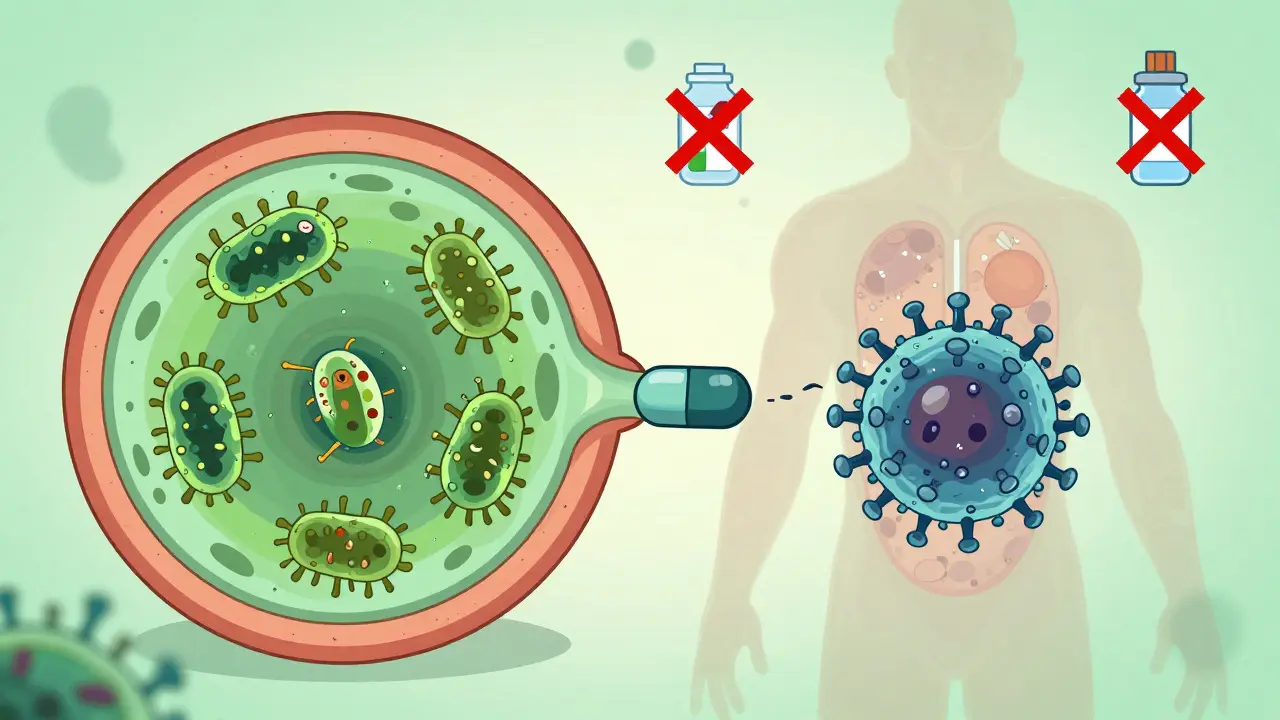
Ever gotten sick and wondered if it’s a cold or a bacterial infection? You’re not alone. Millions of people take antibiotics for a sore throat or cough, only to find out later that the medicine didn’t help-and might have made things worse. The truth is, bacterial vs. viral infections aren’t just different; they require completely opposite treatments. Get it wrong, and you risk side effects, longer illness, or even fueling a global health crisis.
What’s the Real Difference?
Bacteria are living, single-celled organisms. They can survive on their own-in soil, water, or on your skin. They reproduce by splitting in half, sometimes as fast as every 20 minutes. Viruses? They’re not alive. Think of them as genetic material wrapped in a protein shell. They can’t do anything on their own. They need to sneak into your cells and hijack them to copy themselves. That’s why you can’t treat a virus like a bacterial infection.
Size matters too. The biggest viruses are about 300 nanometers wide. The smallest bacteria? Around 200 nanometers. That’s why you can’t see viruses with a regular microscope. You need an electron microscope. This structural gap explains why antibiotics don’t work on viruses. Antibiotics attack things like bacterial cell walls or protein-making machines. Viruses don’t have those. They’re just invaders using your body’s own machinery to replicate.
Common Infections: Know What You’re Fighting
Not all infections are created equal. Here’s what you’re likely to run into:
- Bacterial infections: Strep throat (caused by group A streptococcus), urinary tract infections (UTIs), tuberculosis, and some sinus infections. Strep throat alone affects over 600 million people each year globally. UTIs lead to 8.1 million doctor visits in the U.S. every year.
- Viral infections: The common cold (usually rhinovirus), influenza (flu), chickenpox, and COVID-19. The flu hits 9 to 41 million Americans annually. Before vaccines, chickenpox caused 4 million cases yearly worldwide. And as of 2024, COVID-19 has been linked to over 7 million deaths.
Here’s the kicker: some illnesses start viral and turn bacterial. For example, about half of people hospitalized with severe viral pneumonia-like from COVID-19-end up with a secondary bacterial infection. That’s why doctors sometimes prescribe antibiotics even when the main problem is viral.
Symptoms: How to Tell Them Apart
Symptoms overlap a lot. A fever, sore throat, and cough could mean either. But there are patterns.
With bacterial infections, symptoms tend to be:
- Higher fever (over 101°F or 38.3°C)
- Last longer than 10-14 days
- Get better for a few days, then suddenly get worse
Viral infections usually look like:
- Milder fever (under 100.4°F or 38°C)
- Runny nose, body aches, and cough
- Start improving within 7-10 days
But don’t rely on symptoms alone. A 2023 CDC survey found 68% of people still think antibiotics work on viruses. That’s why testing matters.
Testing and Diagnosis: No Guesswork
Doctors don’t guess anymore. They test.
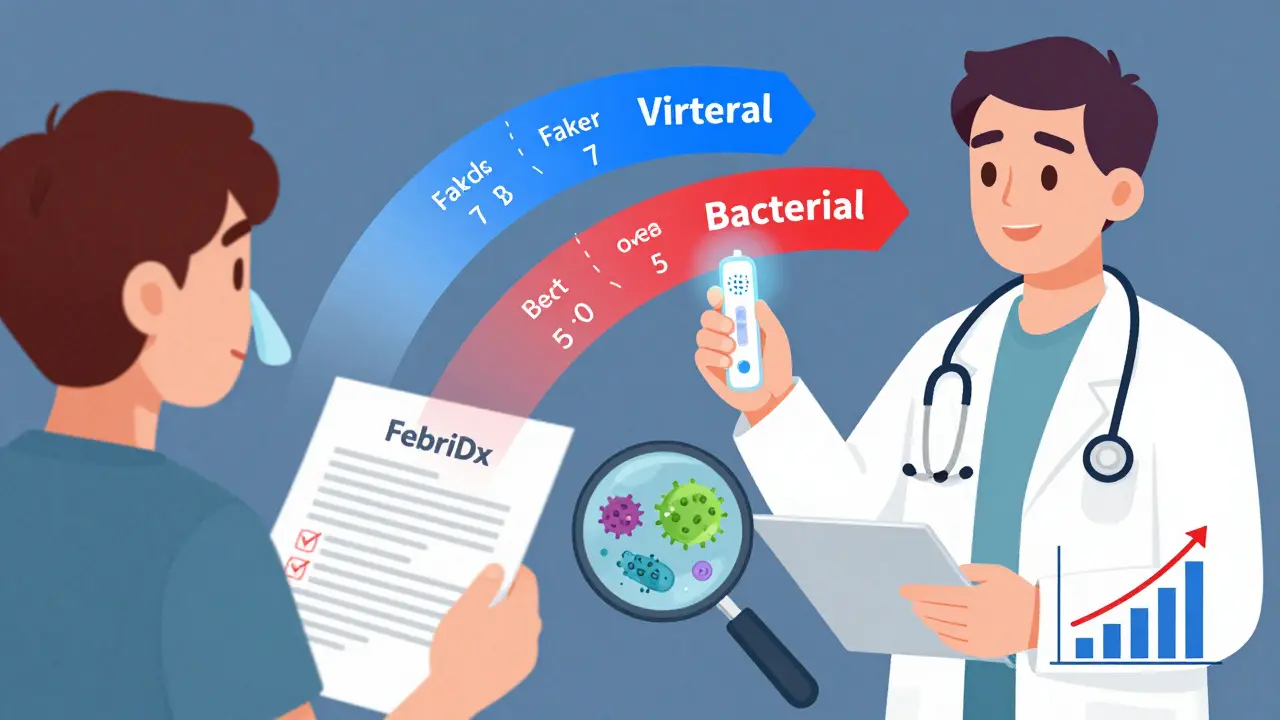
For strep throat, a rapid antigen test gives results in minutes with 95% accuracy. A throat culture is even more reliable-98% accurate-though it takes a day or two. For viruses like flu or COVID-19, PCR tests are the gold standard. They’re 90-95% accurate if done within the first 72 hours of symptoms.
There’s also a newer tool: the FebriDx test. Approved by the FDA in 2020, it checks two biomarkers-CRP (a sign of inflammation) and MxA (a protein made only in response to viruses). In under 10 minutes, it tells you whether your infection is likely bacterial or viral. Studies show it cuts unnecessary antibiotic prescriptions by half in clinics.
For sinus infections, doctors use the Centor Criteria:
- Tonsil exudate (white patches on tonsils) = 1 point
- Tender lymph nodes in the neck = 1 point
- History of fever over 100.4°F = 1 point
- No cough = 1 point
If you score 3 or more, there’s a 50-55% chance it’s bacterial. That’s when testing makes sense.
Treatment: Antibiotics Won’t Fix a Virus
This is the most important thing to remember: antibiotics don’t work on viruses. They’re designed to kill bacteria. Using them for a cold or flu doesn’t help. It just adds risk.
When you take antibiotics unnecessarily:
- You risk side effects like diarrhea, rashes, or yeast infections
- You kill off good bacteria in your gut
- You help create superbugs
In the U.S., about 47 million unnecessary antibiotic prescriptions are written each year for viral infections. That’s not just wasteful-it’s dangerous. The CDC says this contributes to 223,900 cases of Clostridioides difficile (C. diff) infections annually, which cause 12,800 deaths.
For bacterial infections, treatment is straightforward:
- Strep throat: 10 days of penicillin V
- UTI: 3-7 days of trimethoprim-sulfamethoxazole or nitrofurantoin
- Tuberculosis: 6-9 months of multiple antibiotics
For viral infections:
- Rest, fluids, and fever reducers (like acetaminophen or ibuprofen)
- Antivirals only if given early-like oseltamivir (Tamiflu) for flu within 48 hours of symptoms
- Remdesivir for severe COVID-19 in hospital settings
And here’s the reality: most viral infections don’t need any medication. Your immune system clears them. Supportive care is the treatment.
Why Misuse Matters: The Bigger Picture
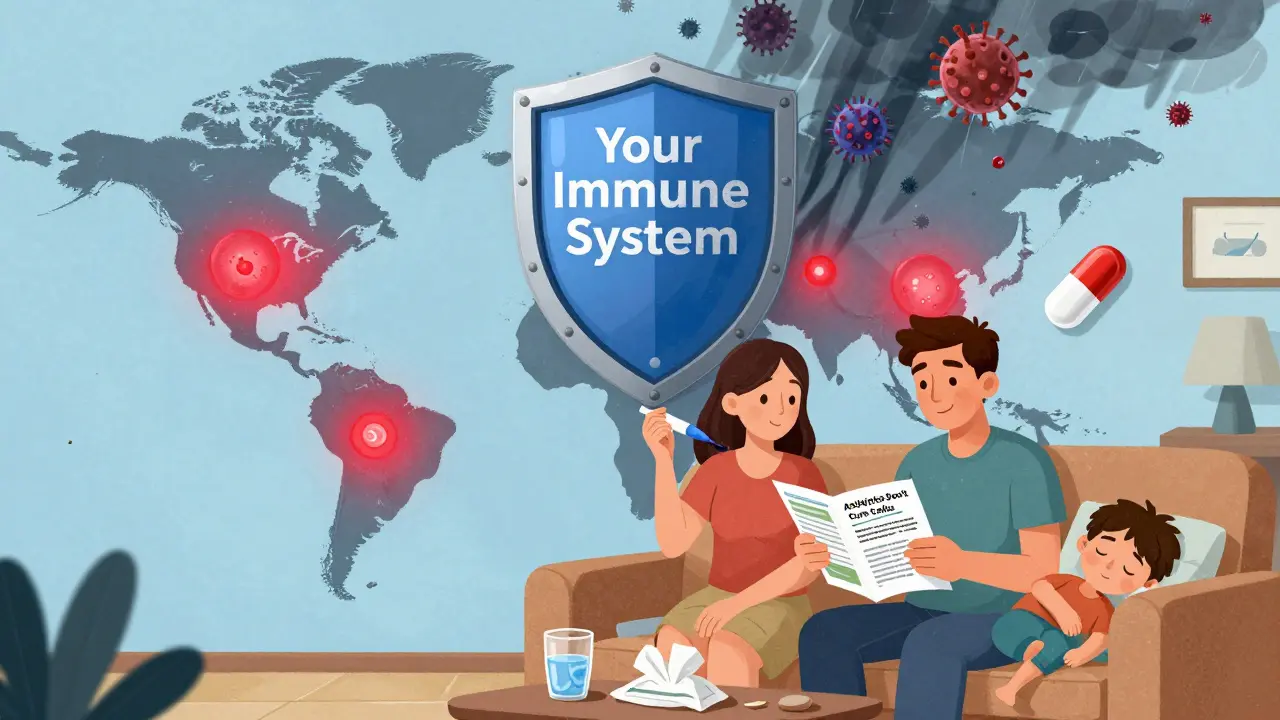
Antibiotic resistance isn’t a future threat. It’s happening now. The WHO calls it one of the top 10 global health threats. In 2019, drug-resistant bacterial infections killed 1.27 million people worldwide. That number could hit 10 million by 2050 if we don’t change.
Here’s what’s happening:
- Resistance to first-line antibiotics for common infections jumped from 5.8% in 2017 to 17.3% in 2023.
- In the U.S. alone, antibiotic-resistant bacteria cause 35,900 deaths each year.
- The economic cost? $1.1 billion a year just in unnecessary prescriptions.
Meanwhile, viral illnesses cost the U.S. healthcare system $45 billion annually in medical visits and lost workdays. Kids get 6-8 viral infections a year. That’s 22 million missed school days and 20 million lost workdays for parents.
And it’s not just about taking pills. New tools are emerging:
- Phage therapy-using viruses that infect bacteria-is showing 85% success in European trials for hard-to-treat infections.
- Researchers at the University of Queensland are testing two new compounds (IMB-001 and IMB-002) that target bacterial surface activity.
- Universal coronavirus vaccines are in Phase III trials, aiming to prevent future pandemics.
What Should You Do?
If you’re sick:
- Don’t demand antibiotics. Ask: “Is this bacterial or viral?”
- Track your symptoms. If they improve in 7-10 days, it’s likely viral.
- If symptoms get worse after 5-7 days, or you have a high fever, see a doctor.
- For kids, remember: 85% of bronchitis and 70% of sinus infections are viral. Antibiotics won’t help.
- Use pain relievers, rest, and fluids. That’s the best treatment for most colds and flus.
And if you’re a parent, teacher, or caregiver: educate others. Misunderstanding this isn’t harmless. It’s a public health problem.
Can antibiotics treat a viral infection like the flu?
No. Antibiotics target bacteria, not viruses. The flu is caused by a virus, so antibiotics won’t shorten your illness or help you feel better. Taking them anyway increases your risk of side effects and contributes to antibiotic resistance. Antiviral drugs like oseltamivir (Tamiflu) can help if taken within 48 hours of symptoms, but they’re not antibiotics.
Why do doctors sometimes prescribe antibiotics for colds or coughs?
Sometimes, it’s because symptoms last longer than expected, or they worsen after a few days. That can signal a secondary bacterial infection-like bacterial sinusitis or pneumonia following a viral cold. Doctors don’t prescribe antibiotics for the virus itself, but for the bacterial complication that may have developed. That’s why timing matters: if you’re getting better after 7-10 days, you likely don’t need them.
How can I tell if my child’s sore throat is strep or just a virus?
Strep throat usually comes with a high fever, swollen tonsils with white patches, and swollen lymph nodes-but no cough or runny nose. Viral sore throats often come with a runny nose, cough, hoarseness, or pink eye. A rapid strep test or throat culture is the only reliable way to confirm. Don’t rely on symptoms alone: about 30% of sore throats are misdiagnosed without testing.
Is it true that I can become resistant to antibiotics?
You don’t become resistant. The bacteria do. Every time you take an antibiotic, some bacteria survive and pass on their resistance genes. Over time, those superbugs multiply. That’s why overuse of antibiotics leads to infections that are harder to treat-like MRSA or drug-resistant tuberculosis. It’s not about your body; it’s about the microbes evolving around you.
What should I do if my doctor says I don’t need antibiotics?
Ask: "What can I do to feel better?" Most viral infections need rest, fluids, and symptom relief-not pills. Use over-the-counter pain relievers, saline nasal sprays, humidifiers, and warm drinks. If symptoms worsen after 7-10 days, or you develop a high fever, return for a recheck. It’s not a failure to not get antibiotics-it’s smart medicine.
Final Thought: Treat the Cause, Not Just the Symptom
Getting sick is part of life. But treating it wisely isn’t optional. Whether it’s a cold, a cough, or a fever, knowing the difference between bacterial and viral infections saves lives-yours and others’. Antibiotics are powerful tools, but only when used correctly. The next time you or someone you care about gets sick, ask: "What’s the real cause?" That simple question could help stop the next superbug before it starts.

8 Comments
Been sick twice this year. First time, I begged for antibiotics. Second time, I asked, "Is this viral?" Turns out, yes. Slept for three days, drank broth like it was my job, and bounced back. No pills. Just patience. Turns out, my body knows what it's doing.
Antibiotics aren't magic. They're tools. And like any tool, misuse just breaks the whole damn system.
Oh honey. You took antibiotics for a cold? Sweetie. You're not sick-you're a walking CDC cautionary tale.
I mean, I get it. You saw a fever, panicked, Googled "antibiotics for flu," and ordered some off a sketchy site. Congrats. You just helped evolve a new strain of bacteria that now has your name on it. Next time, try a thermometer. Or better yet-don't.
Also, phage therapy is coming. And it's gonna make your "penicillin from 1952" mindset look like a dinosaur in a tuxedo.
The fundamental error in public health discourse around antibiotics isn't ignorance-it's anthropomorphism. We treat bacteria like villains in a superhero movie, when in reality, they're just organisms doing what life does: survive, replicate, adapt.
Antibiotics don't 'kill bad bacteria'-they create evolutionary bottlenecks. The ones that survive? They're not evil. They're just better at not dying. And now, because we've overused these drugs like they're candy, we're in an arms race with a species that reproduces faster than we can write prescriptions.
The real tragedy? We're not fighting bacteria. We're fighting our own arrogance. We think we're smarter than evolution. We're not. We're just louder. And louder doesn't win wars-it just makes more noise before the collapse.
My mom used to say, "If it's viral, rest. If it's bacterial, see a doctor." Simple. Wise.
And honestly? I'm tired of people treating doctors like pharmacists. You don't go to a mechanic and say, "Just give me the spark plugs," then get mad when they don't hand them over. You explain the problem. Same here.
Also-yes, I used FebriDx last winter. It told me viral. I didn't take antibiotics. I felt better in 5 days. No guilt. No side effects. Just… life.
Why are Westerners so lazy? You want pills for everything. In India, we know: fever? Drink ginger tea. Cough? Honey and black pepper. Sinus? Steam with eucalyptus. We don't need your fancy tests or your overpriced antibiotics.
And yet-you still die of antibiotic resistance. Why? Because you believe in science only when it comes in a pill bottle. Your culture is sick. Not your body. Your SYSTEM.
Meanwhile, in rural Tamil Nadu, a grandmother treated a child's UTI with neem leaves and saved them from hospitalization. No prescription. No cost. Just wisdom.
You need to stop outsourcing your health to Big Pharma. The answer isn't in a lab. It's in your kitchen.
While the emotional tone of some responses may be hyperbolic, the underlying data presented in the original post is empirically sound and aligns with current clinical guidelines from the CDC, WHO, and peer-reviewed literature (e.g., The Lancet Infectious Diseases, 2023).
It is scientifically accurate that antibiotics target bacterial cell wall synthesis, protein translation machinery, and DNA replication-none of which are present in viral particles. Viruses, being obligate intracellular parasites, lack these targets entirely.
Furthermore, the statistical claims regarding unnecessary prescriptions (47 million annually in the U.S.) and C. diff incidence (223,900 cases) are corroborated by CDC surveillance data. The FebriDx test's 50% reduction in inappropriate antibiotic use has been validated in multiple RCTs, including a 2022 study in JAMA Internal Medicine.
Therefore, while cultural narratives may vary, the biomedical facts remain invariant. Public education must be grounded in precision, not rhetoric.
So you're telling me I didn't need that amoxicillin for my 'sinus infection' last winter? Wow. My nose is still running, but at least my gut flora is alive.
Next time I'm sick, I'm just gonna stare at the ceiling and whisper, 'I believe in you, immune system.'
Also, phage therapy sounds like a sci-fi movie. I'm in.
You know what’s wild? The same people who won’t take antibiotics for a cold will line up for a $400 IV drip of vitamin C and colloidal silver. We’re not rational. We’re emotional creatures who want magic bullets.
And that’s why public health fails-not because people are dumb, but because we’ve turned medicine into a transaction. You want relief? Give me a pill. You want to feel like you did something? Take a pill.
The truth? The best medicine for most viral infections is silence. Quiet. Rest. Water. Time.
But silence doesn’t sell. Pills do.
So we keep buying. And bacteria keep winning.