
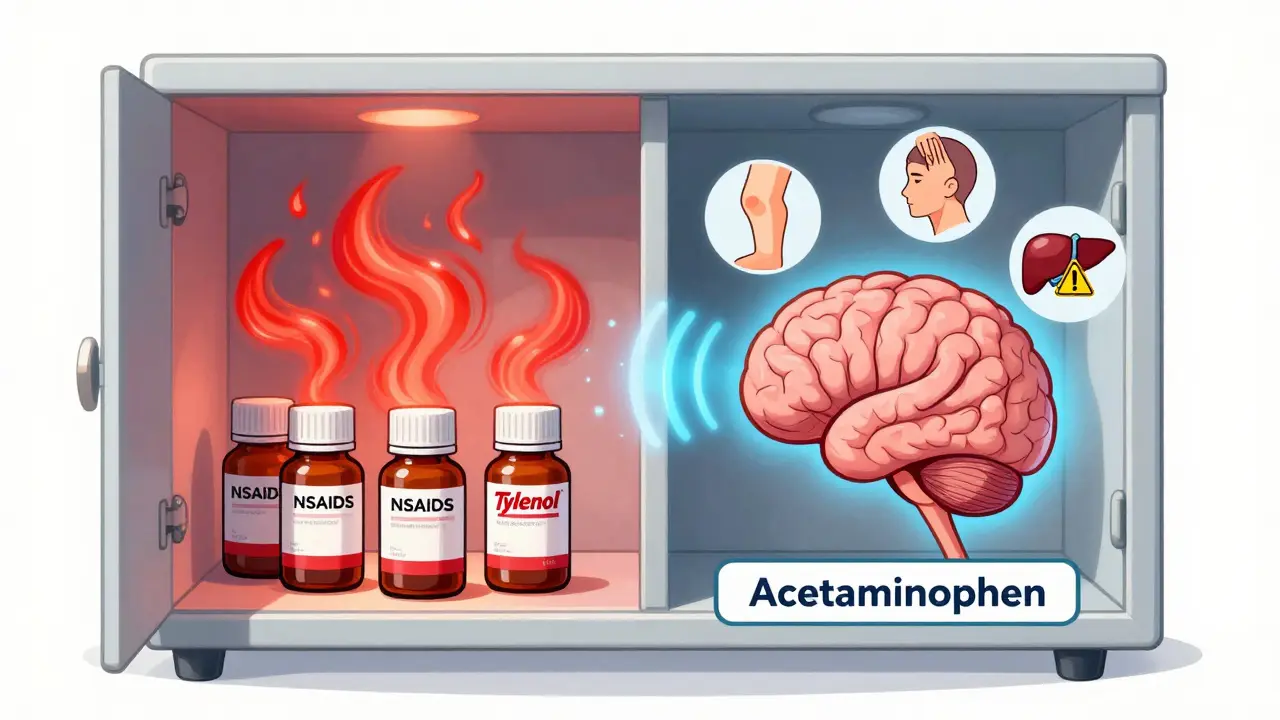
When your back hurts, your head throbs, or your knees ache after a long day, you reach for the medicine cabinet. But between the bottle of ibuprofen and the box of Tylenol, which one should you pick? It’s not just about what’s on sale or what you’ve always used. The difference between NSAIDs and acetaminophen isn’t just brand names-it’s how your body responds, what kind of pain you have, and even your long-term health.
How They Work (And Why It Matters)
NSAIDs like ibuprofen (Advil, Motrin) and naproxen (Aleve) don’t just mask pain-they fight the cause. They block enzymes called COX-1 and COX-2 that produce prostaglandins, chemicals that trigger inflammation, swelling, and pain at the site of injury. That’s why they work so well for sprained ankles, arthritis flare-ups, or menstrual cramps. The swelling is part of the problem, and NSAIDs cut it off at the source.
Acetaminophen (Tylenol) works differently. It doesn’t touch inflammation much at all. Instead, it seems to interfere with pain signals in the brain and spinal cord. That’s why it’s great for headaches, fevers, or general aches-but it won’t help much if your knee is swollen and hot to the touch. Scientists still don’t fully understand how acetaminophen does its job, which makes it a bit of a mystery compared to the well-mapped action of NSAIDs.
When to Choose NSAIDs
If your pain comes with redness, heat, or swelling, NSAIDs are usually the better pick. That includes:
- Arthritis pain in knees, hips, or hands
- Back or neck pain from muscle strain or disc issues
- Sprains, bruises, or tendonitis
- Menstrual cramps
Studies from the Hospital for Special Surgery show NSAIDs give noticeably better relief for osteoarthritis than acetaminophen. People with chronic joint pain often report they can move easier and feel less stiffness after taking ibuprofen or naproxen. One 2023 review found that patients with knee osteoarthritis who switched from acetaminophen to an NSAID saw a 30% improvement in mobility scores.
But there’s a catch. NSAIDs can irritate your stomach lining. About 1 in 5 regular users get heartburn, ulcers, or bleeding. Long-term use raises your risk of heart attack and stroke, especially if you’re over 65, have high blood pressure, or already have heart disease. The FDA has required black box warnings on all NSAIDs since 2005 for this reason. They can also stress your kidneys, especially if you’re dehydrated or take diuretics.
When Acetaminophen Is the Safer Bet
Acetaminophen doesn’t touch inflammation, but it also doesn’t mess with your stomach, kidneys, or heart the way NSAIDs do. That’s why doctors often recommend it first for:
- Headaches and migraines
- Fever from colds or flu
- Toothaches or minor injuries without swelling
- Pain in people with high blood pressure or heart disease
- Those taking blood thinners like warfarin
It’s also the go-to for people who can’t tolerate NSAIDs. If you’ve ever had a stomach ulcer or are on aspirin for heart protection, acetaminophen won’t interfere. It’s even safe for most pregnant women, unlike NSAIDs, which are usually avoided after 20 weeks of pregnancy.
But here’s the danger: acetaminophen is a silent killer if you take too much. The liver processes it, and if you hit more than 4,000 milligrams in 24 hours-equivalent to eight extra-strength pills-you risk liver failure. The FDA says over 56,000 ER visits each year in the U.S. are due to accidental overdose. Most of those happen because people don’t realize they’re doubling up. Cold medicines, sleep aids, and prescription painkillers often contain acetaminophen. You can take Tylenol for a headache, then take a cold tablet later, and suddenly you’ve crossed the line without knowing it.

Dosage Rules You Can’t Ignore
It’s not just about what you take-it’s how much and how often.
Acetaminophen: Maximum 3,000-4,000 mg per day. For safety, aim for 3,000 mg or less, especially if you drink alcohol, have liver disease, or are older. Standard tablets are 325-500 mg. Wait at least 4-6 hours between doses.
Ibuprofen (OTC): 200 mg per tablet. Max 1,200 mg daily (six tablets). Don’t take it for more than 10 days without talking to a doctor.
Naproxen (OTC): 220 mg per tablet. Max 660 mg daily (three tablets). Takes longer to kick in than ibuprofen but lasts longer.
Never crush, chew, or mix these with alcohol. Alcohol increases liver damage risk with acetaminophen and stomach bleeding risk with NSAIDs. And don’t combine them with other painkillers unless your doctor says so.
Can You Take Them Together?
Yes-and many doctors recommend it.
Research from Harvard Health and the Hospital for Special Surgery shows combining acetaminophen and an NSAID can give better pain relief than either alone, while letting you use lower doses of each. That means fewer side effects.
For example: take 650 mg of acetaminophen at 8 a.m. and 8 p.m., and 400 mg of ibuprofen at 2 p.m. and 10 p.m. This keeps pain under control around the clock without overloading your liver or stomach. It’s a common strategy for chronic back pain, post-surgery recovery, or severe arthritis.
But don’t just mix them on your own. Talk to your doctor or pharmacist, especially if you have kidney disease, heart issues, or take other meds. Some combinations can be dangerous.

Who Should Avoid Each One?
Avoid NSAIDs if you have:
- History of stomach ulcers or GI bleeding
- Heart disease, high blood pressure, or stroke risk
- Kidney problems
- Are pregnant after 20 weeks
- Take blood thinners like warfarin or aspirin (ibuprofen can block aspirin’s heart protection)
Avoid acetaminophen if you have:
- Liver disease (cirrhosis, hepatitis)
- Drink 3 or more alcoholic drinks daily
- Are on other medications that contain acetaminophen (check labels)
- Have had a reaction to it before
If you’re unsure, start with acetaminophen. It’s gentler on most systems. If it doesn’t help after a couple of days, switch to an NSAID-or ask your doctor.
Real-Life Scenarios
Case 1: You twisted your ankle playing soccer. Swelling, bruising, pain when you walk. Reach for ibuprofen. It will reduce the swelling and ease the pain. Don’t take it for more than a week without seeing a doctor.
Case 2: You’ve had a headache for two days. No swelling, no fever, just a dull throb. Try acetaminophen first. If it doesn’t help, switch to ibuprofen. Many people find Tylenol works better for headaches because it doesn’t upset their stomach.
Case 3: You’re 68 with osteoarthritis in both knees. NSAIDs help more-but your doctor might still recommend acetaminophen first because of your age and possible heart risks. If acetaminophen isn’t enough, they might suggest alternating it with a low-dose NSAID or switching to a topical NSAID gel to avoid gut issues.
Case 4: You’re on blood pressure meds and get a cold. Avoid NSAIDs-they can raise your blood pressure and mess with your meds. Stick with acetaminophen for fever and aches. Read the cold medicine label carefully-many contain acetaminophen already.
The Bottom Line
There’s no single best painkiller. It depends on your body, your pain, and your history. NSAIDs are stronger for inflammation-based pain but come with more risks. Acetaminophen is gentler on your stomach and heart but can quietly damage your liver if you’re not careful.
Start low. Go slow. Don’t assume what worked last time will work now. And never ignore the labels. The biggest mistake people make isn’t choosing the wrong drug-it’s taking too much of the right one.
If you’re using pain relievers more than a few days a week, talk to your doctor. Chronic pain isn’t something you should manage alone. There are better, safer long-term strategies-physical therapy, weight management, nerve blocks, even mindfulness techniques-that don’t rely on pills.
Can I take ibuprofen and Tylenol together?
Yes, many people safely take them together to get better pain control with lower doses of each. For example, take 650 mg of acetaminophen every 6-8 hours and 400 mg of ibuprofen every 8 hours, spaced out so you’re not hitting both at once. This reduces side effects while keeping pain down. Always check with your doctor first, especially if you have liver or kidney issues.
Which is safer for long-term use?
For most people, acetaminophen is safer for long-term use-if you stay under 3,000 mg per day and don’t drink alcohol. NSAIDs carry higher risks for stomach bleeding, heart attacks, and kidney damage with daily use. But if your pain is from inflammation (like arthritis), acetaminophen might not be enough. In those cases, a low-dose NSAID used occasionally, or a topical version, may be the better long-term choice.
Why does Tylenol not work for my back pain?
Back pain often comes from inflamed muscles or irritated nerves, not just general soreness. Since acetaminophen doesn’t reduce inflammation, it won’t touch the root cause. NSAIDs like ibuprofen or naproxen do. If Tylenol isn’t helping your back, try switching to an NSAID for a few days. If that doesn’t work, you may need physical therapy or another treatment.
Can I give my child acetaminophen or ibuprofen?
Both are safe for children when dosed correctly by weight. Acetaminophen is often preferred for younger kids or those with stomach sensitivity. Ibuprofen works well for fever and inflammation, like ear infections or sore throats. Never give aspirin to children-it can cause Reye’s syndrome, a rare but deadly condition. Always use the measuring tool that comes with the medicine, not a kitchen spoon.
What’s the difference between OTC and prescription versions?
OTC versions are lower-dose and meant for short-term use. Prescription NSAIDs can be higher strength (like 800 mg ibuprofen) or include COX-2 inhibitors like celecoxib, which are easier on the stomach. Prescription acetaminophen is usually combined with opioids (like hydrocodone) for severe pain, but those carry addiction risks. Never take prescription versions without a doctor’s guidance.
Is one better for menstrual cramps?
NSAIDs like ibuprofen or naproxen are usually more effective because menstrual cramps are caused by inflammation in the uterus. Acetaminophen can help, but studies show NSAIDs reduce pain intensity and duration more reliably. Start taking them at the first sign of cramps, not when the pain is already severe.



9 Comments
Been using acetaminophen for years for headaches, but last winter I switched to naproxen for my arthritis and it was a game-changer. Didn't realize how much stiffness I was tolerating until it was gone. Just learned the hard way to never mix with alcohol-ended up in the ER with a stomach bleed. Now I keep a log. Don't be like me.
Acetaminophen is a liver bomb waiting to happen. Everyone thinks it's 'safe' because it's OTC. Lol. Check the label on your NyQuil. You're probably already over the limit. 🤦♀️
Here in Nigeria, we use paracetamol for everything-headache, fever, even back pain. No one talks about NSAIDs. But I read this and now I’m curious… maybe we’re missing something? 🤔
It’s fascinating how medicine still doesn’t fully understand acetaminophen’s mechanism. We’ve mapped the human genome but can’t explain how a simple molecule silences pain without touching inflammation. It’s like the universe whispered the answer and forgot to write it down. Maybe the real breakthrough isn’t in new drugs-but in rethinking how we define pain itself. Is it a signal? A symptom? Or a language our body uses when it’s tired of being ignored?
NSAIDs are blunt instruments. Acetaminophen is a ghost. Both work. Neither should be trusted blindly.
My grandma used to say, 'If it ain't broke, don't fix it.' She took Tylenol for 40 years. Never had a problem. Then one day she took a cold med + Tylenol + her 'joint helper' pills and ended up in the hospital. Liver levels through the roof. She didn't even know the cold medicine had it. Labels are there for a reason. Read 'em. Or your liver will read you.
As a guy who’s been lifting weights since high school, I used to crush ibuprofen like candy. Then I got kidney stones. Turns out, chronic NSAID use + dehydration = bad combo. Now I stick with acetaminophen for soreness and ice for swelling. My body’s not a machine. It’s a delicate ecosystem. Treat it like one.
Big Pharma wants you to believe NSAIDs are dangerous so they can sell you their 'safe' acetaminophen… which is secretly worse. The FDA? Controlled by the drug lobby. Read the studies-most are funded by companies that make these pills. Don’t be fooled. Natural remedies work better anyway. Turmeric. Ginger. Cold showers. 🌿🔥
The assertion that acetaminophen is 'safer' for long-term use is empirically unsound. Hepatotoxicity is dose-dependent and insidious. The 3,000 mg 'recommended' limit is arbitrary, derived from population averages that ignore genetic polymorphisms in CYP2E1 metabolism. Furthermore, conflating 'fewer GI side effects' with 'overall safety' is a fallacy of false dichotomy. One must consider cumulative organ burden, not merely surface-level tolerability.
Actually, the Harvard study they cited? The 2023 review? It was a meta-analysis of 12 trials, but only 3 had proper blinding. Most were industry-sponsored. Also, topical NSAIDs have better safety profiles than oral-why isn’t that mentioned more? And for menstrual cramps, yes, NSAIDs are better, but the real issue is systemic inflammation from diet. Cut the sugar, fix the gut, and you might not need either. Just saying.