
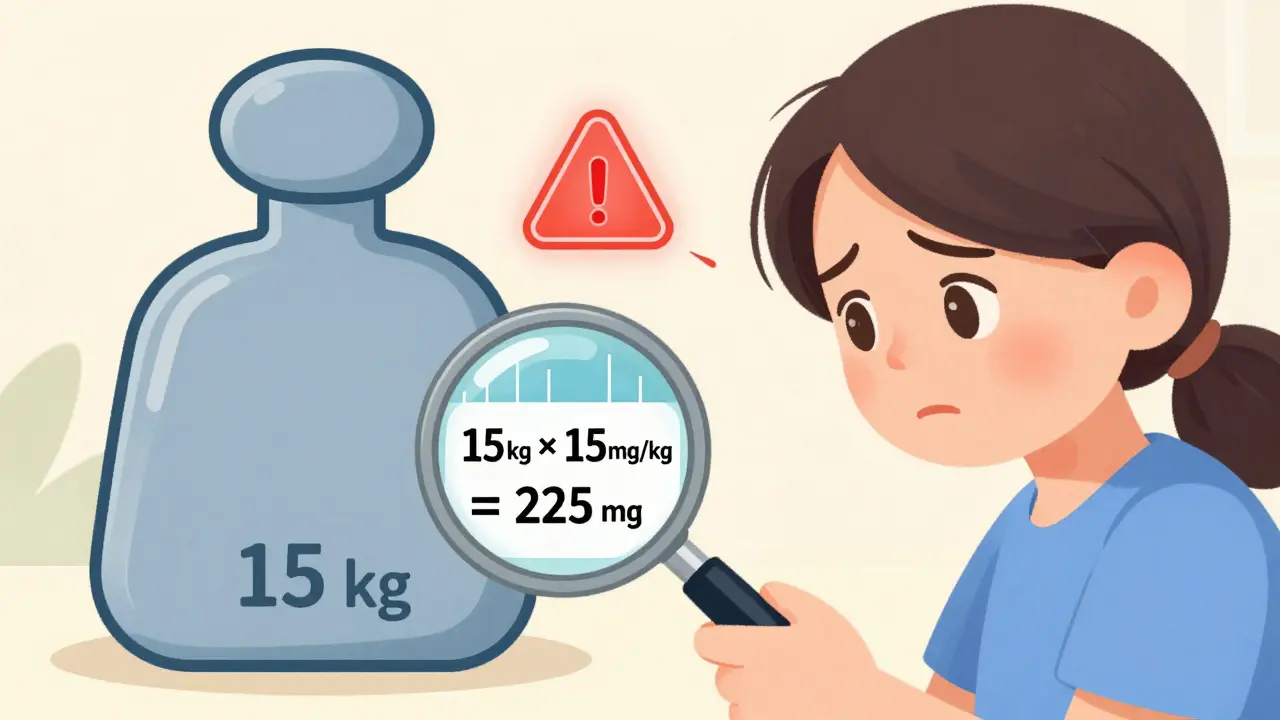
Getting the right dose of medicine for your child isn’t just important-it’s life-or-death. Kids aren’t small adults. Their bodies process drugs differently, and even a tiny mistake in dosage can lead to serious harm. In fact, pediatric dosing errors are three times more common than in adults, and over half of those errors are due to wrong calculations. If you’ve ever stared at a prescription label wondering if 10 mL is too much-or too little-for your 2-year-old, you’re not alone. Here’s how to make sure the dose is safe, accurate, and right for your child’s weight.
Start with the Weight in Kilograms
The first thing you should look for on any pediatric prescription label is the child’s weight in kilograms (kg). If it’s not there, ask for it. Many prescriptions still list weight in pounds, and that’s where mistakes begin. The conversion from pounds to kilograms isn’t just a math problem-it’s a safety step. One wrong decimal point can mean a 10x overdose.Use the exact conversion: 1 kg = 2.2 lb. So if your child weighs 33 pounds, divide 33 by 2.2. That’s 15 kg. No rounding. No guessing. If the label says 33 lb but doesn’t show the kg equivalent, call the pharmacy. A 2022 study found that 22.4% of pediatric dosing errors came from incorrect weight conversions. Don’t let that be your child.
Find the Dose in Milligrams (mg), Not Milliliters (mL)
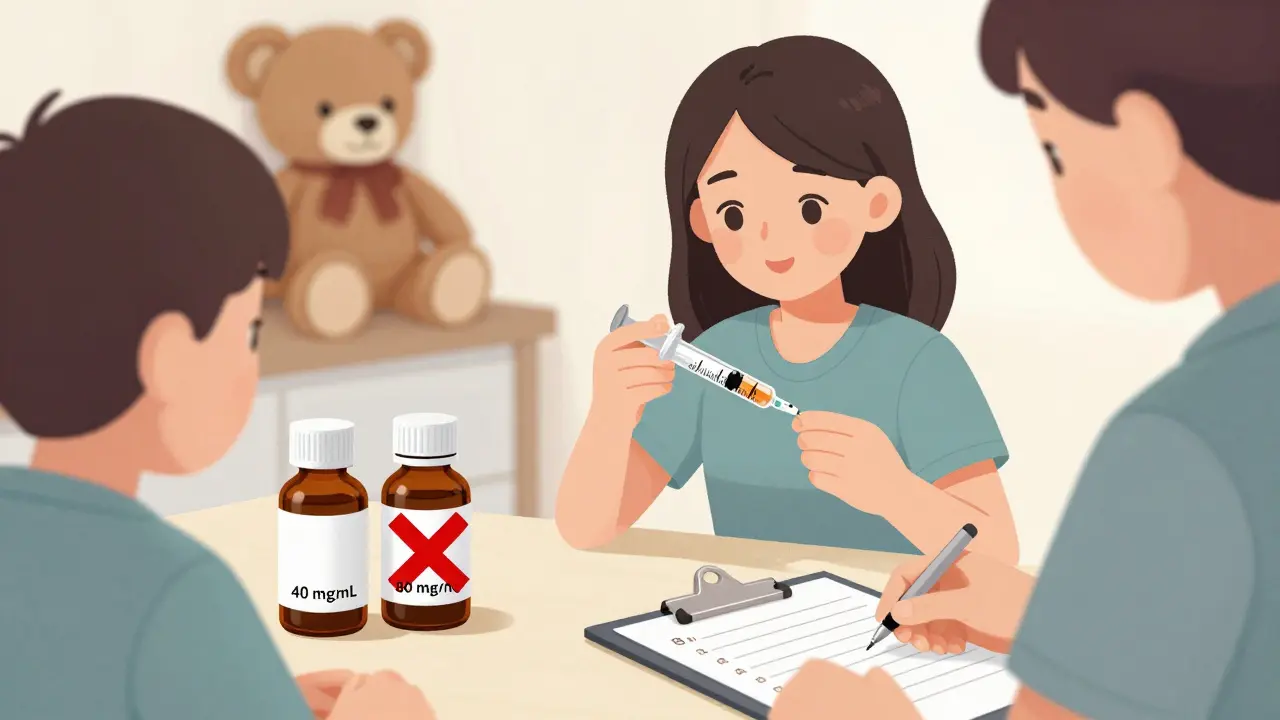
A prescription might say: “Give 10 mL twice daily.” But that doesn’t tell you how much medicine is actually in that dose. The danger? Two different liquid medicines can have the same volume but wildly different amounts of active drug.For example, amoxicillin comes in two common concentrations: 40 mg/mL and 80 mg/mL. If you give 10 mL of the 80 mg/mL version thinking it’s the 40 mg/mL, you’ve just given your child double the intended dose. That’s not a typo-it’s a hospital visit.
Always look for the dose in milligrams (mg) on the label. It should say something like: “200 mg per dose” or “40 mg/kg/day.” If it only says “10 mL,” ask: “What’s the total amount of medicine in milligrams?” The FDA’s 2023 guidelines require all pediatric liquid medications to show both volume and mass on the label. If it’s missing, don’t fill it. Call the prescriber.
Verify the Dose Is Weight-Based (mg/kg)
The gold standard for pediatric dosing is mg/kg-milligrams of medicine per kilogram of body weight. This isn’t just a recommendation; it’s the law in most children’s hospitals and required by the American Society of Health-System Pharmacists (ASHP) since 2021.Here’s how to check it yourself:
- Find the child’s weight in kg (from Step 1).
- Find the prescribed dose per kg (e.g., 15 mg/kg).
- Multiply: 15 kg × 15 mg/kg = 225 mg total daily dose.
- Check how many times a day it’s given (e.g., twice daily): 225 mg ÷ 2 = 112.5 mg per dose.
If the label says “150 mg per dose,” that’s close-but not exact. Is it rounded? That’s okay if it’s within safe limits. But if it says “250 mg per dose,” that’s 120% too high. Ask the pharmacist: “Is this rounded? Is it still safe?”
Some medications, like chemotherapy drugs, use body surface area (BSA) instead of weight. That’s more complex and should only be handled by specialists. For most common drugs-antibiotics, fever reducers, allergy meds-mg/kg is the rule.
Check the Concentration on the Bottle
The label on the bottle you pick up from the pharmacy must match the prescription. Don’t assume. Always compare:- What the doctor ordered: “Amoxicillin 400 mg/day in two doses”
- What the bottle says: “Amoxicillin 40 mg/mL”
- What the syringe measures: “Each mL = 40 mg”
Then calculate: If your child needs 200 mg per dose, and the concentration is 40 mg/mL, you need 5 mL. If the bottle says 80 mg/mL, you’d only need 2.5 mL. Same dose. Half the volume. Use the right syringe. Don’t use a kitchen spoon. Don’t guess. Use the measuring device that came with the medicine.
A 2021 CDC report found that 37.2% of errors in children under 2 came from concentration confusion. One mother in a Reddit thread described a near-miss where the pharmacy gave her amoxicillin-clavulanate at 80 mg/mL instead of 40 mg/mL. She noticed the volume was half of what she expected and called the doctor. It saved her son from a dangerous overdose.
Use the Two-Person Rule
In hospitals, every pediatric dose is checked by two people: a pharmacist and a nurse. That’s not just bureaucracy-it’s a proven safety net. At home, you can do the same thing.Ask another adult to verify the math. Your partner, a relative, even a friend with a science background. Have them do the calculation independently. If you both get the same answer, you’re likely safe. If you disagree, stop. Call the pharmacy. Don’t guess.
Dr. Robert L. Wears, a patient safety expert, says: “Pediatric dose verification requires at least two independent calculations using different methods.” That’s not optional. It’s essential.
Ask the Pharmacist These Three Questions
When you pick up the prescription, don’t just take it and go. Ask:- “What is the exact dose in milligrams, not milliliters?” This forces them to state the active ingredient amount.
- “Is this dose appropriate for my child’s current weight?” This makes them confirm the mg/kg calculation.
- “Can you show me how to measure this dose with the provided device?” Many parents use the wrong syringe or misread the lines.
These questions are not rude-they’re necessary. Pharmacists expect them. In fact, the American Academy of Pediatrics recommends parents ask these exact questions.
Watch Out for Common Traps
Here are the top mistakes parents and even some providers make:- Confusing concentration: “Is this 160 mg/5 mL or 160 mg/1 mL?” Always read the fine print.
- Using the wrong measuring tool: A teaspoon from your kitchen holds 5 mL, but not accurately. Use the syringe or cup that came with the medicine.
- Assuming “adult dose divided” is safe: Clark’s Rule (weight/150 × adult dose) is outdated. It’s not precise enough for kids.
- Ignoring rounding rules: Some systems round 1.8 mL to 2 mL. That’s usually fine. But 4.8 mL rounded to 5 mL on a high-dose drug can be dangerous. Ask: “Is this rounded up or down?”
A nurse with 12 years in pediatric ICU once told me: “The most dangerous situation is when parents see a dose that seems too small for an adult but don’t realize it’s correct for their child’s weight.” That’s the mindset you need: trust the math, not your gut.
Technology Can Help-But Don’t Rely on It Alone
Many hospitals now use AI-powered tools like DoseSpot or EPIC’s Haiku app that check doses against national guidelines. These systems are 98-99% accurate. But they’re not perfect. They can miss if the weight is entered wrong or if the concentration isn’t selected properly.Even with tech, the human check is still required. In 2024, the American Academy of Pediatrics made it mandatory: all pediatric prescriptions must include the child’s weight in kilograms and the calculated dose in milligrams. That’s a big step forward. But if you’re getting a prescription from a clinic that doesn’t use electronic records, you’re still the last line of defense.
Look for smart technology like Philips’ IntelliSpace system, which connects to digital scales and auto-fills weight into prescriptions. It’s coming to more hospitals in 2024 and 2025. But until then, you’ve got to do the math.
What to Do If Something Feels Off
If the dose seems too high, too low, or just weird-trust your gut. You know your child better than anyone. Here’s what to do:- Call the pharmacy and ask them to re-read the prescription label aloud.
- Call the doctor’s office and ask: “Can you confirm the dose is 200 mg per dose for a 15 kg child?”
- Check the manufacturer’s dosing chart. Most drug companies have free online tools or printed charts (e.g., Tylenol, Motrin).
- If you’re still unsure, don’t give it. Wait. Call again. Get a second opinion.
One mother in Birmingham caught a 3x overdose because she compared her child’s acetaminophen label to the box from the last bottle. The concentration had changed, and the new label didn’t say so clearly. She called the pharmacy-they apologized and corrected it. Her child never took the wrong dose.
That’s not luck. That’s vigilance.
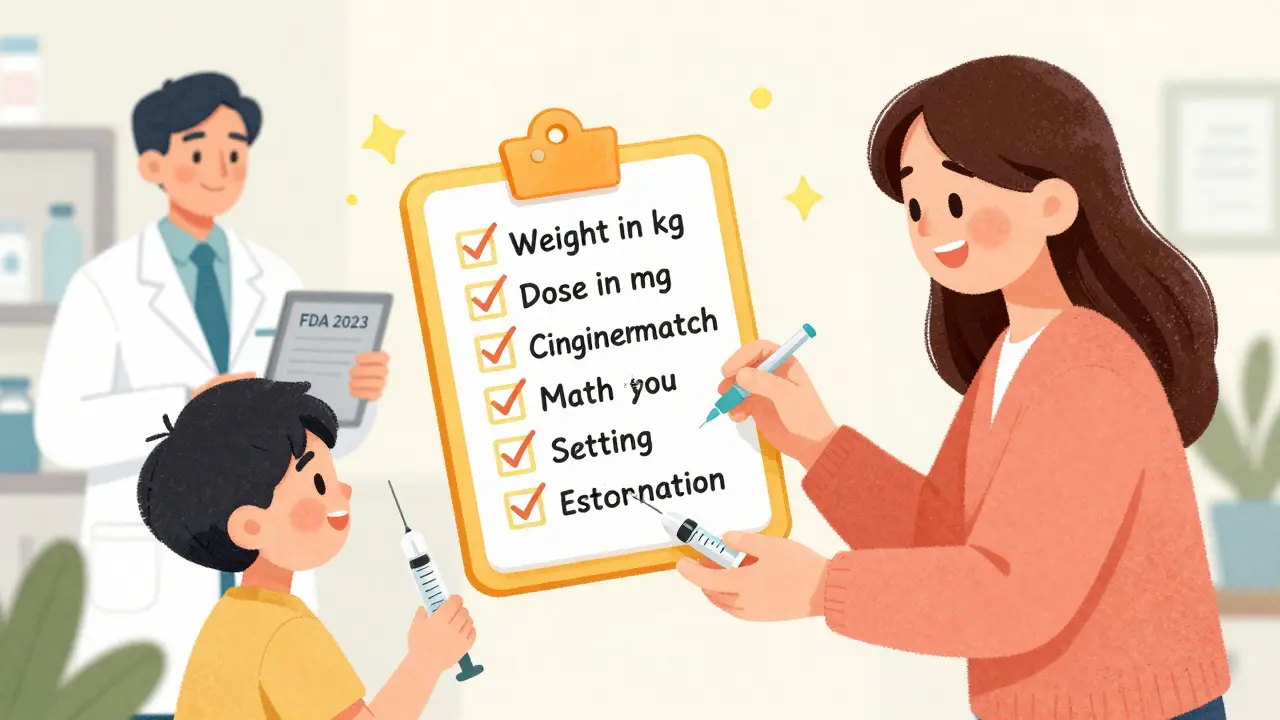
Final Checklist: Before You Give the Medicine
Before you open the bottle, run through this quick list:- ✅ Child’s weight is listed in kg (not just pounds)
- ✅ Dose is written in mg (not just mL)
- ✅ Concentration (mg/mL) matches the bottle
- ✅ Calculation: weight (kg) × dose (mg/kg) = total daily dose
- ✅ Total daily dose divided by frequency = dose per administration
- ✅ You’re using the correct measuring device
- ✅ Another adult has verified the math
If all seven boxes are checked, you’re doing better than 80% of parents-and better than many providers. Pediatric dosing isn’t complicated. It just requires attention. And that’s something you already have.
What should I do if the prescription doesn’t list my child’s weight in kilograms?
Call the prescribing doctor or pharmacy immediately. A pediatric prescription without the child’s weight in kilograms is incomplete and potentially unsafe. Ask them to provide the weight in kg and the calculated dose in mg. If they refuse or can’t provide it, do not fill the prescription until it’s corrected.
Can I use a kitchen spoon to measure liquid medicine?
No. Kitchen spoons vary in size and are not accurate. Always use the syringe, dropper, or dosing cup that came with the medicine. These are calibrated for precise measurements. Using a spoon can lead to underdosing or overdosing by 25% or more.
Why do some pediatric medicines have two different concentrations?
Different concentrations exist to make dosing easier for different age groups. For example, infants often get 80 mg/mL to avoid giving large volumes, while older children get 40 mg/mL. Always check the concentration on the bottle and match it to the prescription. Never assume the concentration is the same as the last time.
Is it safe to give my child half of an adult dose?
No. Adult doses are not simply divided by two for children. Children’s doses are based on weight (mg/kg) or body surface area, not age or size alone. Giving half an adult dose could be too much or too little. Always use a weight-based calculation.
What if my child’s weight has changed since the prescription was written?
If your child has gained or lost more than 10% of their weight since the prescription was written, call the doctor. Dosing is calculated based on current weight. A 20-pound weight change in a toddler can mean a 30% difference in dose. Don’t wait-update the prescription.
How do I know if the pharmacy made a mistake?
Compare the label on the bottle to the prescription. Does the concentration match? Is the dose in mg correct for your child’s weight? If anything looks off, ask the pharmacist to recheck. Most pharmacies have a pharmacist on duty who can review the order. Don’t hesitate-your child’s safety is worth the call.


15 Comments
Why are we still using milligrams and kilograms in the US? This is 2024. We should be using metric everywhere, but nope-parents are still doing math like it’s 1987. It’s insane. The FDA should mandate all prescriptions be in metric-only. No exceptions. No excuses. Stop making parents calculate their kid’s life or death.
This is exactly the kind of guide every new parent needs. I wish I’d had this when my daughter was on antibiotics last year. I almost gave her the wrong dose because I trusted the pharmacy’s label without checking the concentration. Thank you for writing this.
In India, we face the opposite problem-pharmacies often give you a bottle without any concentration printed, and you’re left guessing. I once had to call three pharmacies to find one that had the right amoxicillin strength for my nephew. This guide should be translated into every major language and posted in every pediatric clinic worldwide. Knowledge is the only vaccine against dosage errors.
I’m a nurse, and I’ve seen too many parents panic because the dose looks too small. One mom cried because her 18-month-old was getting 7.5 mL-she thought it was ‘too little’ and wanted to double it. I had to sit with her for 20 minutes to walk through the math. It’s heartbreaking. This post should be mandatory reading for every parent before they leave the hospital with a newborn.
My son had a near-miss with a concentration mix-up last winter. The pharmacy gave him 80 mg/mL instead of 40 mg/mL. I noticed the volume was half of what I expected and called the doctor. Turns out, they’d misread the script. I still get chills thinking about it. This checklist? Print it. Laminate it. Tape it to the fridge.
It’s not just about dosing-it’s about the systemic failure of a medical-industrial complex that treats children as afterthoughts. The fact that we still rely on parents to be amateur pharmacists while hospitals outsource prescriptions to underpaid technicians with no pediatric training is a moral catastrophe. We’ve outsourced child safety to the emotional labor of exhausted mothers. This isn’t guidance-it’s damage control for a broken system.
So… you’re telling me the burden of verifying pediatric dosing falls entirely on the parent? Not the prescribing physician? Not the pharmacist? Not the EHR system? That’s not safety-it’s systemic abandonment. If this were a car, we’d sue the manufacturer. But because it’s a child’s medicine, we just hand out checklists and call it a day. Brilliant.
They’re lying to you. The government doesn’t care about your kid. They want you to be confused so you’ll take the wrong dose and get sick. Then they sell you more medicine. This whole thing is a scam. The real dose is always higher than what’s printed. Always. Don’t trust the label. Don’t trust the pharmacist. Trust your gut. And if you’re still unsure? Don’t give it. Just wait. They’ll come to you.
It is with the utmost reverence for the sanctity of pediatric pharmacological integrity that I commend the author of this meticulously structured, empirically grounded, and clinically rigorous exposition on dosage verification protocols. The integration of weight-based calculations, concentration validation, and the two-person verification paradigm constitutes a paradigmatic shift in community-based medication safety. I respectfully urge all healthcare institutions to adopt this framework as a national standard, and to mandate its inclusion in all pediatric orientation curricula.
My cousin’s kid died because the pharmacy gave him the wrong concentration. They didn’t even call the doctor. Just handed it over. Now they’re saying ‘we’re sorry’ and offering a $50 gift card. This isn’t a checklist. It’s a funeral.
Ha! In India, we don’t even get labels. Just a plastic bag with a scribbled note: ‘Give 5 mL twice.’ No concentration. No weight. No nothing. We just guess. I used to use my thumb to measure. Then I learned about syringes. Now I carry one everywhere. This guide? It’s a luxury. But if you have it? Use it. And if you don’t? Pray harder.
Did you know that 89% of pediatric dosing errors occur because parents don’t have a background in pharmacology? That’s why we need mandatory certification for parents before they’re allowed to administer any medication. This isn’t a suggestion. It’s a public health imperative. I’ve drafted a bill. I’ll send it to your inbox.
This is an exemplary model of patient-centered safety education. The integration of weight-based dosing, concentration verification, and the two-person rule reflects best practices endorsed by the WHO and ASHP. I have distributed this guide to all parents in my community health outreach program. Thank you for your rigorous attention to detail and your unwavering commitment to child welfare.
YES. This. I printed this out and stuck it on my fridge next to the emergency numbers. My wife and I check it every time we give medicine. We even have a little ritual-we high-five after we both agree on the dose. It’s weird, but it works. And hey-if it saves one kid from getting too much Tylenol, it’s worth it.