
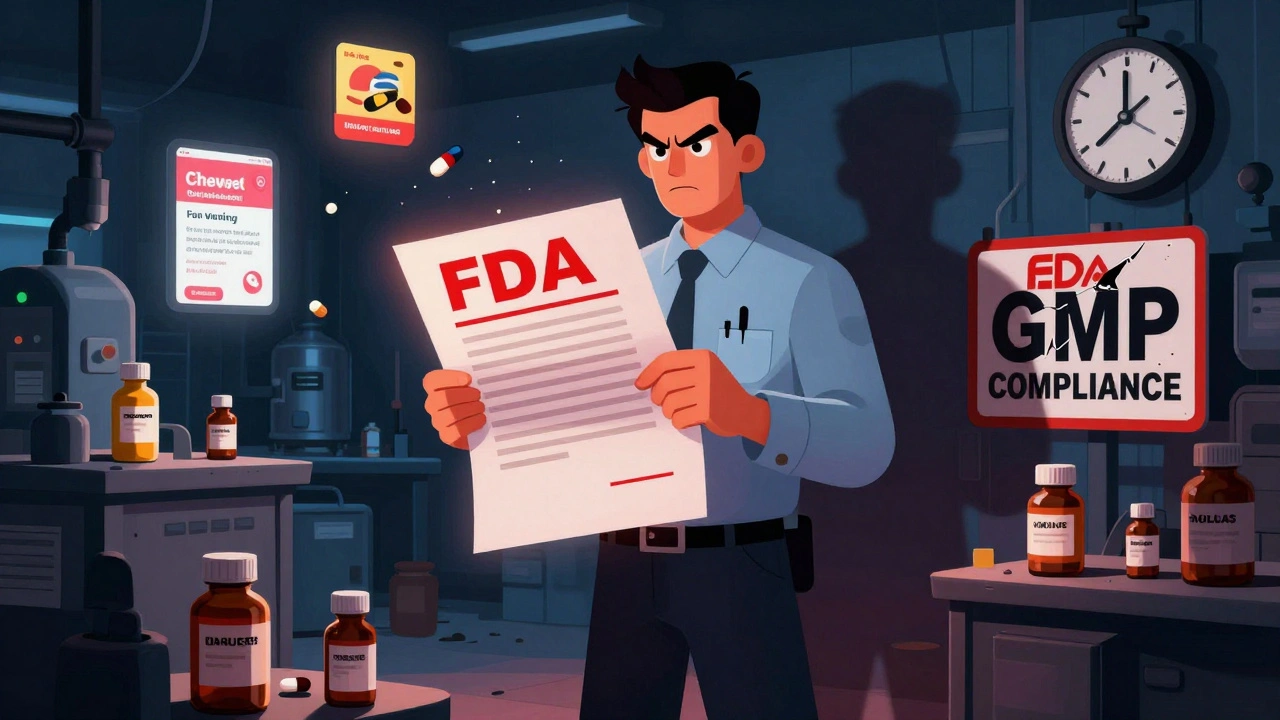
The FDA doesn’t just watch over drug and food safety-it acts. When companies cut corners, mislabel products, or ignore safety rules, the agency doesn’t wait. It sends a FDA warning letter. This isn’t a gentle reminder. It’s the first official step in a chain of consequences that can end with a product being pulled from shelves, a factory shut down, or even criminal charges.
What a Warning Letter Really Means
A warning letter from the FDA isn’t optional. It’s a legal notice that says: You broke the rules, and we’re watching. These letters are issued under the Federal Food, Drug, and Cosmetic Act (FDCA), the law that’s been governing this space since 1938. But since 2023, under Commissioner Robert Califf, the FDA has returned to a much stricter approach-issuing hundreds of these letters each year, just like in the 1990s.These letters don’t just list problems. They name the exact violations: misbranding, failing to follow good manufacturing practices, selling unapproved drugs, or making false claims about products. For example, in 2025, the FDA sent 58 warning letters to companies compounding GLP-1 medications like semaglutide and tirzepatide. These were being marketed as weight-loss drugs without approval, often through telehealth sites and social media ads. The letters cited violations under Sections 502(a) and 502(bb) of the FDCA-specific rules about labeling and safety.
Companies get 15 business days to respond. That’s not a suggestion. It’s a deadline. If they don’t respond, or if their plan is weak, the FDA moves to the next step.
How the FDA Escalates
Warning letters are just the start. The FDA has a full toolbox of enforcement tools, and they use them in order:- Untitled Letters: For minor issues, like unclear advertising. Less serious, but still official.
- FDA Form 483: Given during inspections. Lists observations of problems-like dirty equipment or missing records. If this happens, a warning letter often follows.
- Import Alerts: If a product from overseas keeps failing inspections, the FDA can block it at the border without even opening the package. This is called “Detention Without Physical Examination.”
- Recall Notices: Voluntary or forced removal of unsafe products from stores and pharmacies.
- Withdrawal of Approval: The nuclear option. The FDA can pull the license for a drug or device entirely.
For food manufacturers, the focus has shifted from old-style cGMP violations to newer Food Safety Modernization Act (FSMA) rules. In 2024 alone, the FDA issued 149 warning letters to human food facilities for failing to implement risk-based preventive controls. That’s a big change-now it’s not just about cleanliness, it’s about predicting and preventing contamination before it happens.
Who’s Getting Targeted?
Not all industries get the same attention. Some are under fire more than others.Tobacco products are a top priority. Since 2021, the FDA has issued over 700 warning letters to companies selling unauthorized e-cigarettes and vaping devices-especially those with flavors that appeal to teens. These letters target everything from packaging to online ads. The agency says it won’t tolerate products that hook kids.
Compounding pharmacies are another hotspot. These labs mix custom drugs, often for patients with allergies or special needs. But many started making mass-produced versions of popular drugs like semaglutide and selling them as if they were FDA-approved. The FDA says that’s illegal-and they’re cracking down hard. In the first half of 2025, 58 warning letters went out to these companies, many tied to telehealth platforms pushing these drugs online.
Foreign manufacturers are also under new scrutiny. In May 2025, the FDA expanded its program of unannounced inspections for overseas facilities. Previously, inspections were scheduled and predictable. Now, inspectors can show up without warning. If a company refuses access, delays inspections, or hides records, they could face criminal charges under Section 303(f) of the FDCA. That’s not a fine-it’s jail time.

What Happens After the Letter?
Receiving a warning letter isn’t the end-it’s the beginning of a high-stakes response process. Companies must act fast. The FDA doesn’t give second chances unless you prove you’ve fixed the problem.Responses must include:
- Specific steps taken to correct each violation
- Proof those steps worked (test results, training logs, updated procedures)
- A timeline for full compliance
If the FDA isn’t satisfied, they can impose Civil Monetary Penalties (CMPs)-up to $1 million per violation. For a company selling hundreds of units of a mislabeled drug, that adds up fast.
Some companies try to ignore the letter. That’s a mistake. The FDA keeps records of every warning letter. They’re public. Investors, partners, and pharmacies check them. A single warning letter can destroy a brand’s reputation-even if the issue is fixed.
New Rules, New Power
Something changed in how these letters are signed. Before, they were often signed by lower-level staff in the Office of Prescription Drug Promotion (OPDP). Now, they’re signed by the directors of CDER (Center for Drug Evaluation and Research) or CBER (Center for Biologics Evaluation and Research)-the top officials. That signals something: the FDA is treating these letters as serious enforcement actions, not just advice.And the language is sharper. Older letters said, “We request you stop.” New ones say, “We require you take immediate action.” There’s no room for ambiguity.
The agency is also centralizing decisions. More warning letters now require approval from the Office of the Commissioner. That means fewer inconsistent rulings and more uniform enforcement across all product types.

What Manufacturers Need to Do Now
If you’re making drugs, food, or medical devices sold in the U.S., here’s what you must do:- Know the rules-cGMP, FSMA, labeling laws. Don’t assume your lawyer knows them all.
- Train your team. Quality control, marketing, and customer service all need to understand FDA boundaries.
- Prepare for unannounced inspections. Especially if you’re overseas.
- Never delete or redact records during an inspection. That’s a criminal offense.
- Have a response plan ready. If a warning letter arrives, don’t wait. As legal experts say: treat it like a regulatory emergency.
The FDA isn’t trying to shut down honest businesses. But they’re done tolerating shortcuts. If your product puts people at risk, they will find you-and they will act.
What’s Next?
The FDA’s 2026 budget includes $50 million for more inspectors, better tech, and faster enforcement. Unannounced inspections are set to increase by 300% over the next two years. Digital marketing violations-like Instagram ads for unapproved drugs-are being tracked more closely than ever.Manufacturers who think they can outlast the system are wrong. The FDA’s tools are stronger, their staff are better trained, and their patience is gone. Compliance isn’t optional. It’s the price of doing business in the U.S. market.
What happens if I ignore an FDA warning letter?
If you ignore an FDA warning letter, the agency will escalate. This could mean a recall, import detention, civil penalties up to $1 million per violation, or even criminal charges. The FDA tracks every letter, and failure to respond is seen as a sign of disregard for safety-making future enforcement even harsher.
Can the FDA shut down a factory without a court order?
The FDA can’t directly shut down a facility, but they can take actions that effectively do the same. They can issue a warning letter, followed by a seizure of products, an import alert blocking shipments, or a withdrawal of approval for the product. Without approved products, the facility loses its reason to operate. In extreme cases, they can recommend criminal prosecution, which can lead to a court-ordered shutdown.
Are FDA warning letters public?
Yes. All FDA warning letters are posted on the agency’s website and are easily searchable by company name or product. They’re considered public records and are used by investors, competitors, and healthcare providers to assess a company’s compliance history.
How long does it take to get an FDA warning letter after an inspection?
After an inspection, if issues are found, the FDA typically issues a Form 483 on-site. A warning letter follows within weeks to months, depending on the complexity of the violations and the company’s response. In high-priority areas like tobacco or compounded drugs, letters can be issued within 30 days.
Can a company appeal an FDA warning letter?
You can’t formally appeal a warning letter, but you can respond with evidence that the violations were corrected or misunderstood. The FDA will review your response and may close the case if satisfied. If you believe the letter is factually wrong, you can request a formal meeting with the agency. However, ignoring it or publicly disputing it without evidence can worsen the situation.
Do warning letters apply to foreign manufacturers?
Yes. The FDA has jurisdiction over any product sold in the U.S., regardless of where it’s made. Foreign manufacturers receive warning letters just like U.S.-based companies. Many now face unannounced inspections, and failure to comply can result in import alerts that block their products at the border permanently.



10 Comments
Too much bureaucracy. They’re just scared of innovation.
so like if u make a supplement and say it helps u lose weight u get a letter? wow. the fda is so strict now. they used to let stuff slide.
They’re using this to scare small businesses so Big Pharma can dominate. You think this is about safety? Nah. It’s about control.
Of course the FDA’s cracking down-foreign labs are flooding our market with junk. We need to protect American health, not let some overseas factory with no standards sell poison to our kids.
And yet… they still let Big Pharma get away with $10,000 pills and silent side effects… but a small compounding pharmacy uses the word ‘weight loss’? BAN THEM! FIRE THE CEO! CALL THE MEDIA!!
It’s not about safety-it’s about who you know and how loud you scream. The FDA’s a circus, and we’re all just clowns in the front row.
They’ll shut down a guy making semaglutide in his garage… but let a Fortune 500 company market a drug that causes heart attacks and call it ‘a rare side effect’?
Where’s the justice? Where’s the consistency? Where’s the moral backbone?!
I’ve seen the data. I’ve read the letters. It’s not enforcement-it’s performance.
They want headlines, not health.
And now they’re sending inspectors to foreign labs? What next? Surveillance drones over pharmacies?
They’re not protecting us-they’re building a regulatory empire. And we’re the fuel.
They’ll take your business. Your livelihood. Your dreams. All because you used the word ‘miracle’ in an Instagram ad.
Wake up. This isn’t science. It’s spectacle.
And they’re winning.
I really appreciate how detailed this post is-it’s easy to feel overwhelmed by all the rules, but breaking it down like this helps so much. I work in a small food startup, and honestly, I was terrified of inspections until I read about FSMA and preventive controls. Now I have a checklist, and my team actually looks forward to the audits because we know we’re doing things right. It’s not about fear-it’s about building trust. With customers, with regulators, with ourselves. And yeah, the deadlines are tight, but that’s what makes you better. I’ve seen companies turn warnings into wins by responding with real change, not just paperwork. You don’t have to be perfect-you just have to be honest, prepared, and willing to learn. And if you’re reading this and feeling stuck? You’re not alone. Reach out. Ask for help. There are so many great resources out there, and the FDA actually wants you to succeed… even if their letters sound like a thunderstorm.
So the FDA’s getting stricter… cool 😎
But like… if a guy in Ohio makes gummies with turmeric and says ‘supports immunity’… is that really worse than a pharma giant charging $1000 for a pill that does the same thing but with 17 chemicals no one can pronounce?
Just saying… maybe the real problem isn’t the small guy trying to help people… it’s the system that lets big players play by different rules 🤔
Also… unannounced inspections? That’s wild. Like… what if I’m in the bathroom? 😅
Interesting how the shift from reactive to preventive compliance under FSMA mirrors systems theory in industrial engineering-especially the application of probabilistic risk models to contamination vectors. The FDA’s moving toward predictive enforcement, which reduces variance in outcomes. But what’s missing is feedback loops from frontline workers who understand operational realities better than compliance officers who’ve never touched a production line. The disconnect between policy design and ground truth is where most failures occur. We need bottom-up data integration, not top-down mandates. Also… typo in the FDCA section-should be 502(a) and 502(aa), not bb. Minor but relevant.
Let’s be real-the FDA’s escalation protocol is textbook bureaucratic theater. Warning letters? A performative gesture designed to create the illusion of action without real teeth. The real power lies in the threat of recall, import detention, and civil penalties-the actual enforcement tools that destroy companies. The letter itself is just the opening salvo, a legal fig leaf. And the fact that they’re now requiring commissioner-level sign-off? That’s not about consistency-it’s about centralizing blame. Someone needs to be held accountable when the press calls. Meanwhile, the small manufacturers who actually fix their issues get buried under a mountain of paperwork while the big players quietly settle out of court. This isn’t regulation. It’s risk management for politicians. And we’re the collateral.
cool info man. i think fda is just trying to keep up with the internet now. people buy stuff online like it’s amazon and dont realize its not approved. maybe they need more education instead of just sending letters. also why so many warnings to indian labs? i mean… they’re not the only ones making stuff. just saying 😊