
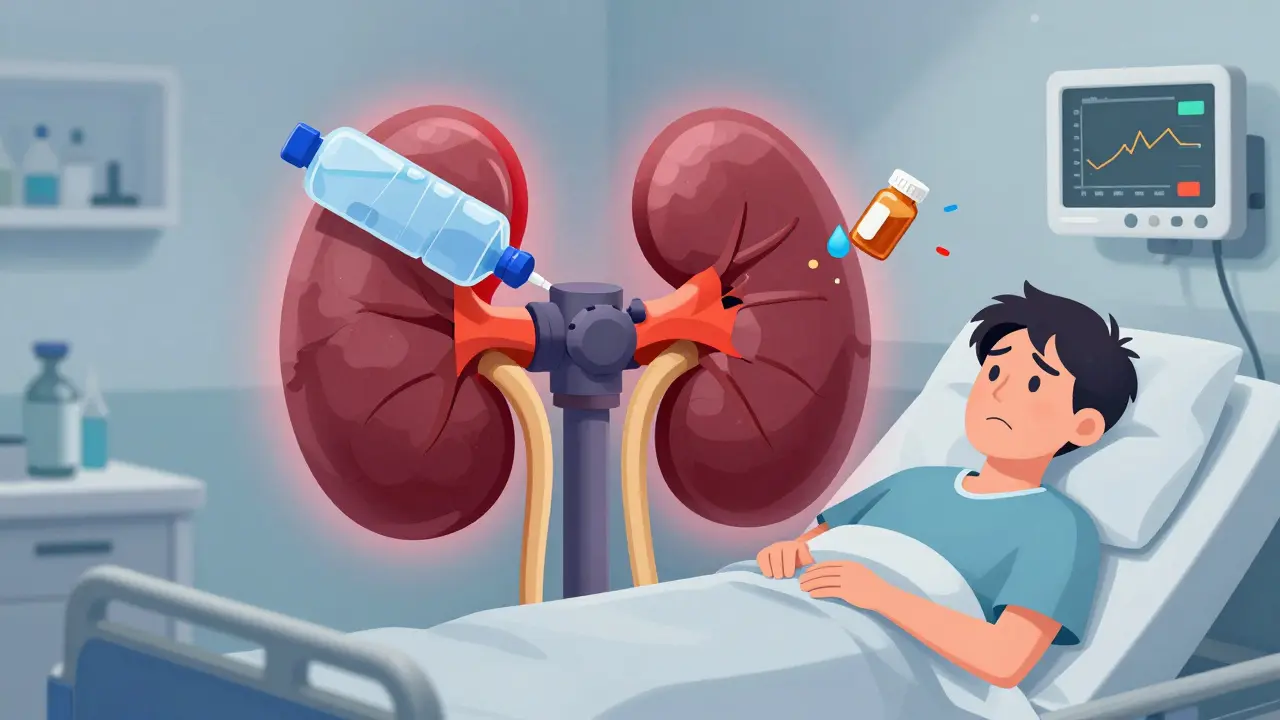
Acute Kidney Injury (AKI) doesn’t come with a warning sign. One day you feel fine; the next, your body starts shutting down - not because of a car crash or a fall, but because your kidneys suddenly stopped doing their job. This isn’t rare. Around 13.3 million people worldwide develop AKI every year. In hospitals, it’s even more common: 20-30% of ICU patients will have it. And for many, it’s the first time they’ve ever heard the word kidney outside of a general checkup.
What Exactly Happens When Your Kidneys Stop Working?
Your kidneys aren’t just filters. They balance fluids, remove waste, control blood pressure, and keep your electrolytes in line. When AKI hits, all of that goes wrong - fast. It’s not a slow decline like chronic kidney disease. AKI happens in hours or days. The classic sign? Your urine output drops. Less than 400 mL a day is called oliguria. Less than 100 mL? That’s anuria. But here’s the twist: not everyone stops peeing. Some people with severe kidney damage still produce normal amounts of urine. That’s why labs matter more than symptoms.The official diagnosis? A rise in serum creatinine. If your creatinine jumps by 0.3 mg/dL in 48 hours, or climbs 50% above your baseline in a week, you’ve got AKI. This is the standard set by KDIGO, the global kidney health group. It’s not just a number. It’s a red flag that your kidneys are struggling to clear toxins. Blood urea nitrogen (BUN) often rises too. And if you’re in the ICU, they’ll be tracking your urine output every hour.
Why Does AKI Happen? Three Main Causes
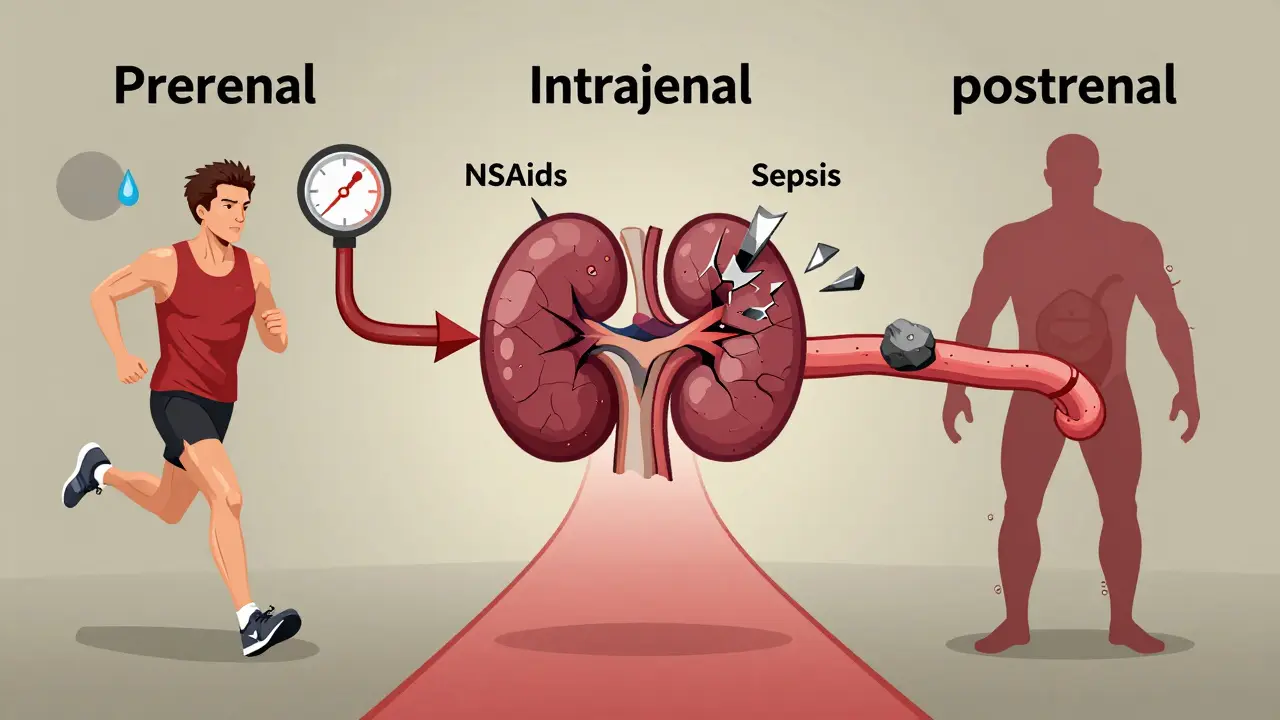
AKI doesn’t come out of nowhere. It’s usually triggered by one of three problems:- Prerenal (60-70% of cases): Your kidneys aren’t getting enough blood. This happens with low blood pressure, heavy bleeding, severe dehydration from vomiting or diarrhea, or heart failure. Your kidneys aren’t broken - they’re just starved. Give them fluid, and they often bounce back fast.
- Intrarenal (25-35%): The kidney tissue itself is damaged. The most common cause? Acute tubular necrosis (ATN). This is often from medications like aminoglycoside antibiotics, contrast dye used in CT scans, or severe infections like sepsis. Glomerulonephritis and lupus can also attack the kidneys directly.
- Postrenal (5-10%): Something’s blocking the flow of urine. In men over 60, it’s often an enlarged prostate. In others, it’s kidney stones or tumors pressing on the ureters. If you’re not peeing well and your kidneys are swollen, this is likely the cause.
Knowing which type you have changes everything. Giving fluids to someone with a blocked ureter won’t help - you need to remove the blockage. Giving a nephrotoxic drug to someone with low blood pressure could make things worse.
What Are the Real Symptoms - Beyond the Lab Results?
You might think swelling and fatigue are the main signs. They are - but they’re not always obvious. About 22% of AKI cases show no symptoms at all. People feel fine until their blood test comes back with a scary creatinine number.When symptoms do show up:
- Swelling in legs, ankles, or face - caused by fluid buildup. In 68% of cases, this is the first visible clue.
- Shortness of breath - fluid in the lungs. Seen in 42% of hospitalized patients.
- Confusion or drowsiness - toxins building up in the brain. Especially common in older adults.
- Nausea, vomiting - your body trying to expel waste it can’t filter.
- Chest pain - could mean pericarditis, an inflammation around the heart from uremic toxins.
- Flank pain - dull ache between ribs and hips. More common in intrinsic kidney damage.
And then there’s hyperkalemia - potassium levels soaring above 5.5 mEq/L. This can cause dangerous heart rhythms. It’s one of the most life-threatening complications. That’s why doctors check potassium levels immediately when AKI is suspected.
How Is It Diagnosed? It’s Not Just a Blood Test
Yes, serum creatinine is key. But diagnosis needs more. Doctors look at:- Urine output - tracked hourly in hospitals.
- Urine sodium and FeNa - if it’s less than 1%, it’s likely prerenal. Over 2%, it’s likely intrinsic damage.
- Renal ultrasound - used in 85% of cases to check for swelling or blockages. It’s quick, safe, and shows if the kidneys are enlarged (suggesting obstruction) or shrunken (suggesting chronic damage).
- CT urography - if stones are suspected, this scan catches them with 95% accuracy.
And now, new tools are emerging. Tests for biomarkers like NGAL (neutrophil gelatinase-associated lipocalin) can predict AKI 24-48 hours before creatinine rises. That’s huge. It means doctors can act before damage becomes irreversible.
Treatment: What Works, and What Doesn’t
There’s no magic pill for AKI. Treatment depends entirely on the cause.Prerenal AKI: Fluids. Simple. Give 500-1000 mL of normal saline. In 70% of cases, kidney function returns within 24-48 hours. No dialysis needed. But give too much fluid to someone with heart failure? That can backfire. Timing and patient history matter.
Intrarenal AKI: Stop the poison. If a drug caused it - stop it. Antibiotics, NSAIDs, contrast dye - all can be culprits. In 65% of drug-induced cases, stopping the trigger leads to improvement within 72 hours. For glomerulonephritis, steroids or immunosuppressants help. In severe cases like hemolytic uremic syndrome, plasmapheresis - filtering the blood - works in 80% of cases if started within 24 hours.
Postrenal AKI: Unblock it. A stent in the ureter? That fixes 90% of cases immediately. For enlarged prostate, a catheter or surgery can restore flow. Delay this, and the kidneys can suffer permanent scarring.
When things get critical - high potassium, fluid overload, or acidosis - dialysis kicks in. About 5-10% of hospitalized AKI patients need it. In the ICU, continuous renal replacement therapy (CRRT) is common. It’s slower, gentler, and better for unstable patients. Peritoneal dialysis? Rare. Only used if veins are too damaged for IV access.
Recovery: Can Your Kidneys Heal?
Yes - but not always. And not always completely.- Prerenal AKI: 70-80% recover full function within a week if treated fast.
- Intrarenal AKI: 40-60% recover partially or fully, but it takes weeks. ATN with prolonged low urine output? Only 20-30% get back to normal.
- Severe AKI needing dialysis: Only 25% recover full kidney function by 3 months.
Some factors make recovery harder:
- Age over 65 - recovery rates drop by 35%.
- Pre-existing kidney disease (eGFR under 60) - cuts recovery chances in half.
- AKI lasting more than 7 days - triples the risk of incomplete recovery.
- Need for dialysis - the longer you’re on it, the less likely your kidneys bounce back.
And here’s the quiet truth: even if your creatinine returns to normal, you’re not out of the woods. A 2022 survey of AKI survivors found that 68% felt exhausted for months after. 42% worried constantly about their kidneys. Many couldn’t return to work for weeks. The mental toll is real.
The Long-Term Risk: Chronic Kidney Disease Lurks
Every episode of AKI changes your kidney’s future. One study showed that after AKI, your risk of developing end-stage kidney disease rises 8.2 times over five years. One in five survivors develop chronic kidney disease within a year. That’s not a small risk. That’s a life-altering one.That’s why follow-up matters. About 45% of AKI patients need to see a nephrologist within six months. They’ll check your eGFR, urine protein, blood pressure - all the things you didn’t think about after you left the hospital. Skipping this step is like ignoring a car’s warning light and hoping the engine doesn’t blow.
What’s Next? The Future of AKI Care
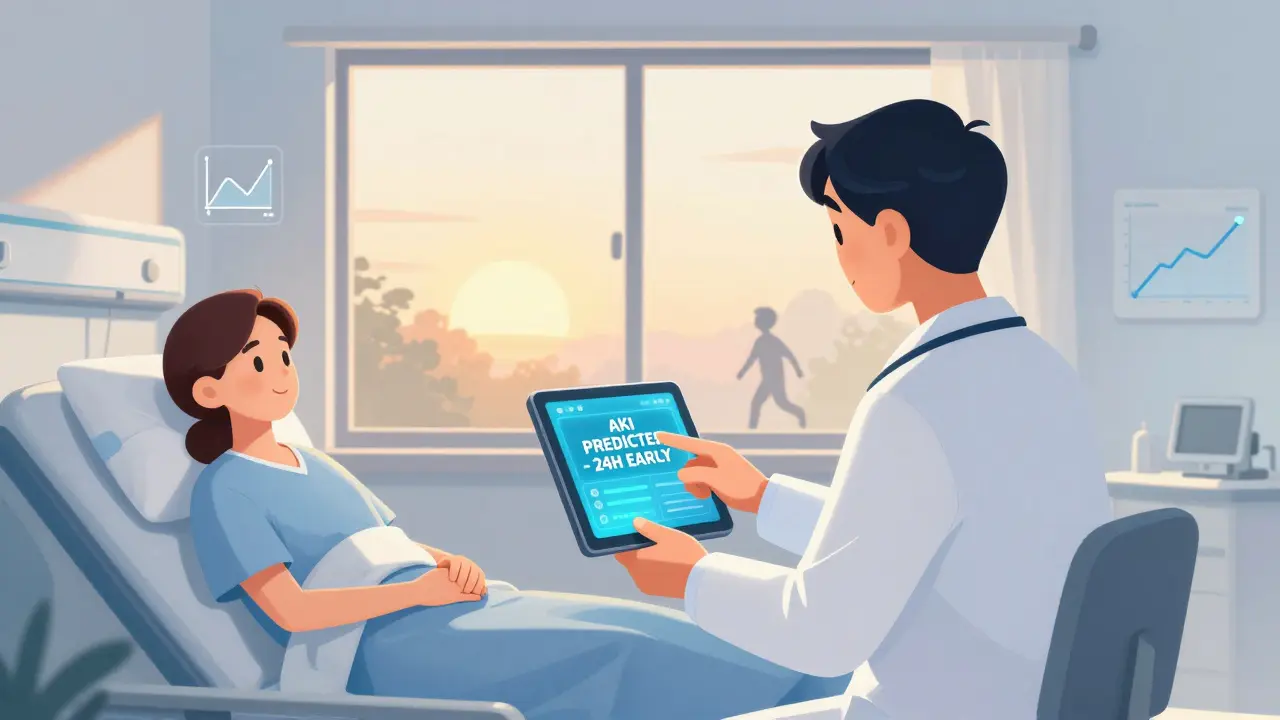
Doctors aren’t waiting for symptoms anymore. New research is focused on predicting AKI before it happens.AI algorithms are being trained on electronic health records to spot patterns - a drop in urine output, a spike in creatinine, a new antibiotic - and flag patients at risk 12-24 hours before AKI develops. Early trials suggest this could cut AKI cases by 20-30%.
And then there are the biomarkers. TIMP-2 and IGFBP7 - proteins released by stressed kidney cells - can predict severe AKI with 85% accuracy just 12 hours after the insult. The STARRT-AKI trial, running across 15 countries, found that starting dialysis earlier in severe cases reduced 90-day death rates by 9%.
It’s not science fiction. It’s happening now. In hospitals that use AKI alerts in their EHR systems, mortality has dropped by 12%.
What You Can Do
If you’re in the hospital - especially if you’re older, have heart disease, or are on multiple meds - ask: “Are you checking my kidney function daily?” Don’t wait for symptoms. Creatinine is cheap. Urine output is easy to track.If you’re recovering from AKI: stay hydrated (but don’t overdo it), avoid NSAIDs like ibuprofen, and keep your blood pressure in check. And don’t ignore that fatigue. It’s not just “being tired.” It’s your body healing.
AKI doesn’t always leave scars. But it leaves a mark. The best outcome? Early detection. Fast action. And never treating it as a one-time event. Your kidneys don’t forget. And neither should you.
Can acute kidney injury be reversed completely?
Yes, in many cases - especially if caught early and the cause is prerenal (like dehydration or low blood pressure). About 70-80% of these cases recover full function within a week. Intrarenal AKI, caused by direct kidney damage, has a lower recovery rate - 40-60% - and often takes weeks. If dialysis was needed, only about 25% regain full kidney function within three months.
What are the warning signs of acute kidney injury?
Common signs include reduced urine output (less than 400 mL/day), swelling in legs or ankles, fatigue, nausea, confusion, and shortness of breath. But 22% of cases show no symptoms at all. That’s why blood tests measuring creatinine and urine output are critical - especially in hospitalized or high-risk patients.
Can medications cause acute kidney injury?
Yes. Common culprits include aminoglycoside antibiotics, NSAIDs like ibuprofen and naproxen, contrast dye used in CT scans, and some blood pressure meds like ACE inhibitors - especially if you’re dehydrated or already have kidney issues. Stopping the offending drug often leads to recovery within 72 hours.
How long does it take to recover from acute kidney injury?
Recovery time depends on the cause and severity. Prerenal AKI often resolves in 24-48 hours with fluids. Intrarenal AKI, like from acute tubular necrosis, can take 2-6 weeks. Severe cases with prolonged low urine output may take months - and some people never fully recover. Age, pre-existing kidney disease, and need for dialysis all slow recovery.
Is acute kidney injury the same as chronic kidney disease?
No. AKI is a sudden, often reversible loss of kidney function over hours or days. Chronic kidney disease (CKD) is a slow, progressive decline over months or years. But AKI can lead to CKD - about 23% of survivors develop stage 3 or higher CKD within a year. Each episode increases long-term kidney damage risk.
Can I prevent acute kidney injury?
You can reduce your risk. Stay hydrated, especially when sick with vomiting or diarrhea. Avoid NSAIDs if you’re dehydrated or have kidney problems. Tell your doctor about all your meds before any imaging test with contrast dye. If you’re hospitalized, ask for daily creatinine checks. Early detection saves kidneys.


8 Comments
Man, I had no idea AKI could hit so fast. My grandma went from fine to on dialysis in 3 days after a bad UTI. They didn’t even check her creatinine until she was confused. 😔
This is one of those posts that makes you realize how much we take our kidneys for granted. I used to chug coffee and skip water like it was a sport. Not anymore. 🙏
People need to stop treating their bodies like disposable machines. If you're taking NSAIDs like candy and not hydrating, you're asking for trouble. This isn't rocket science.
Why do hospitals even wait for creatinine to spike? Why not just test everyone daily? This feels like negligence dressed up as medicine.
Thank you for sharing this with such clarity. As someone who works in global health outreach, I've seen how easily AKI is missed in underserved communities. The biomarker advances you mentioned? They're game-changers - if they're accessible. We need equity in early detection, not just innovation. Please, let's not leave anyone behind.
Also, typo: 'eGFR under 60' should be 'eGFR below 60' - just a small thing, but precision matters in medical comms.
It’s wild how the body whispers before it screams. AKI is like the universe’s way of saying, ‘You ignored the signs, now pay attention.’ We’re all just temporary vessels, but some of us forget that until the alarm goes off. 🌌
Still… I wonder if the real crisis isn’t the kidney failure - it’s the cultural silence around organ health. We’ll google symptoms for a pimple but ignore the quiet hum of our insides until they scream.
Carolyn, I’m so sorry your grandma went through that. That’s exactly why I ask for creatinine checks now when I’m hospitalized. My dad had prerenal AKI after pneumonia - fluids fixed it in 36 hours. But if they’d waited for swelling or fatigue? He might’ve needed dialysis.
Greg, you’re right - hydration isn’t optional. I used to think ‘drink when thirsty’ was enough. Turns out, your kidneys don’t care about your schedule. They need consistent input.
And Crystal - you’re not wrong about daily testing. In trauma units, they do. In general wards? Not so much. That gap is deadly. We need protocols, not luck.
LMAO so AKI is just ‘you drank too much soda and didn’t poop enough’? Bro. I’m 28, work out, drink water, and still got flagged for a 0.4 creatinine spike after a CT scan. They gave me a lecture like I committed a sin. Meanwhile, the guy next to me was on 12 meds and didn’t get a single warning. System’s broken.