
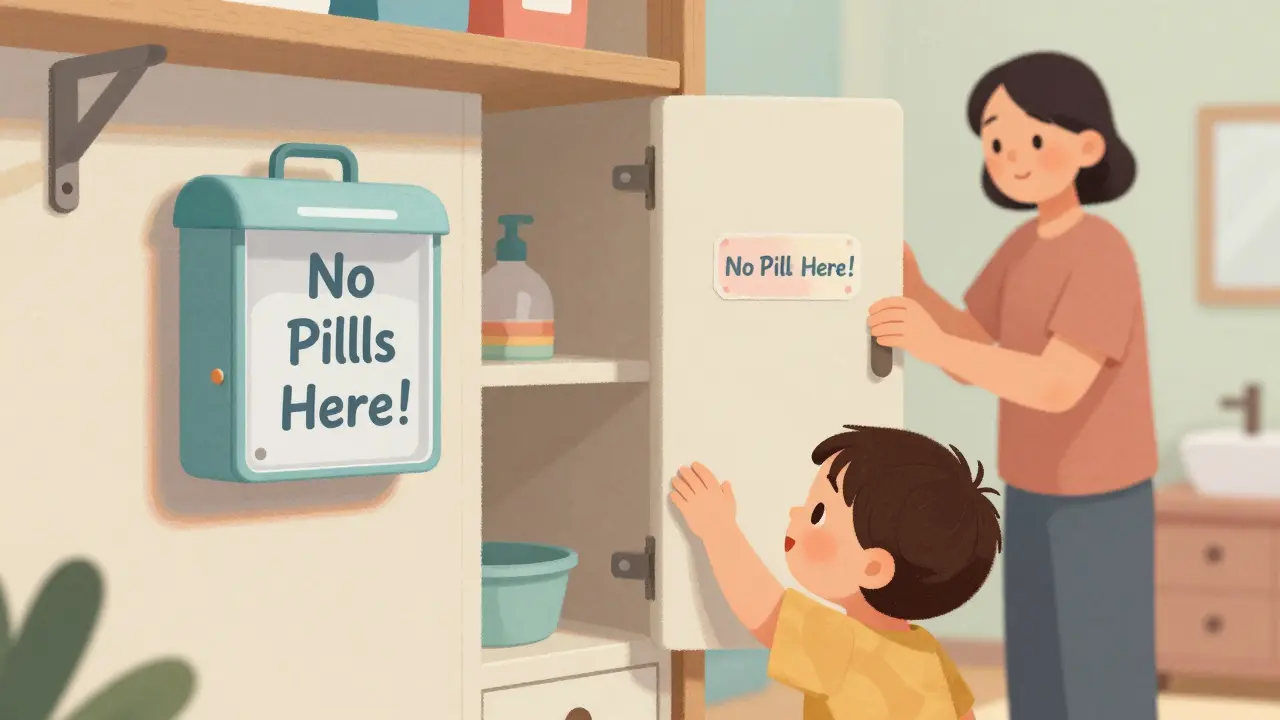
Every year, around 60,000 children in the U.S. end up in the emergency room because they got into medications they shouldn’t have. Most of these cases aren’t from street drugs - they’re from pills sitting in a bathroom cabinet, a nightstand drawer, or even a purse left on the kitchen counter. If you or someone in your home takes high-risk medications like opioids, benzodiazepines, or stimulants, storing them safely isn’t optional. It’s a necessity. And the most effective way to do that? A medication lockbox.
Why a Lockbox Is the Only Real Solution
Child-resistant caps sound good, but they’re not enough. Studies show that half of all kids aged 4 to 5 can open them in under a minute. Hidden spots? Kids find them. One study found 72% of children locate hidden stashes within 30 minutes. Even a locked cabinet won’t help if the key is taped under the mat. Lockboxes are the only option that creates a true physical barrier - no matter how curious, strong, or clever the person trying to get in is. The CDC, the American Academy of Pediatrics, and SAMHSA all agree: if you have opioids like oxycodone or hydrocodone, benzodiazepines like Xanax, or stimulants like Adderall in your home, you need a lockbox. These aren’t just strong drugs - they’re deadly if misused. In 2021, over 16,700 people died from prescription opioid overdoses. Many of those cases started with someone in the household - a teen, a guest, even a grandchild - finding the pills.What Counts as a High-Risk Medication?
Not every pill needs a lockbox. But these do:- Opioids: Oxycodone (OxyContin, Percocet), hydrocodone (Vicodin, Norco), fentanyl patches, morphine
- Benzodiazepines: Alprazolam (Xanax), diazepam (Valium), clonazepam (Klonopin)
- Stimulants: Dextroamphetamine-amphetamine (Adderall), methylphenidate (Ritalin, Concerta)
- Other high-risk drugs: Certain sleep aids (zolpidem), muscle relaxants (carisoprodol), and some pain patches
Choosing the Right Lockbox
Not all lockboxes are the same. Here’s what to look for:- Size: For one person’s meds, a 6x4x3 inch box is fine. For a family with multiple prescriptions, go for 10x8x6 inches. Make sure it fits your largest bottle or patch container.
- Lock type: Key locks are simple but risk losing the key. Combination locks (3-4 digits) are common and affordable. Biometric (fingerprint) models cost more - around $35-$60 - but are ideal for older adults or anyone with arthritis. No keys. No codes. Just touch and open.
- Material: Look for steel or heavy-duty ABS plastic. Fire resistance matters - some boxes can survive up to 30 minutes in 1,700°F heat. Not a guarantee, but it helps.
- Mounting: Wall-mountable boxes are best. Kids can’t move them. Some even come with screws and anchors.
- Climate control: If you store insulin or other refrigerated meds, you need a special box with a cooling feature. Most standard lockboxes are for room temperature storage only.
Where to Put It - And Where NOT to Put It
Location matters more than you think. Here’s what works:- Best spots: A bedroom closet, a high shelf in a home office, a locked drawer in a dresser - any place only adults can reach.
- Mount it: Screw it to the wall. No one can carry it off.
- Keep it dry: Never store it in the bathroom. Humidity ruins pills and can damage the lock mechanism.
- On the kitchen counter
- In the medicine cabinet (even if it’s locked - kids know where those are)
- Under the bed
- In a purse, backpack, or car glove compartment
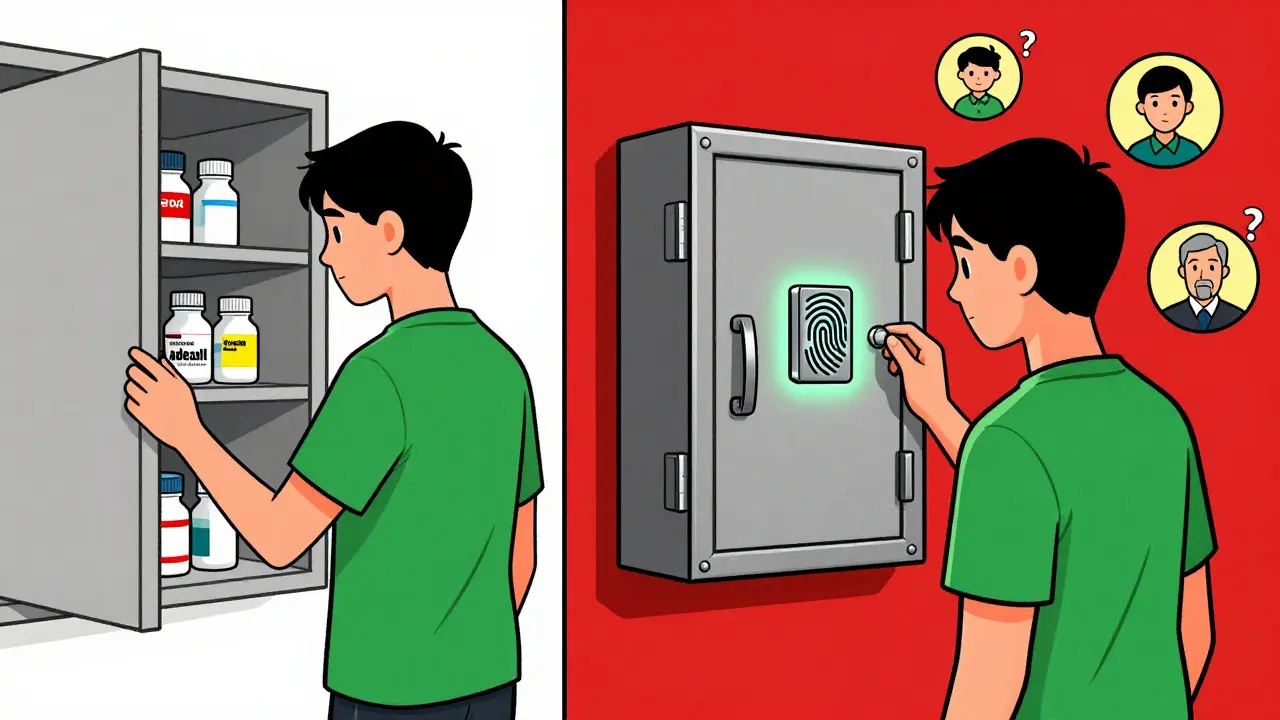
How to Set It Up - Step by Step
1. Take inventory. Pull out every prescription and OTC bottle. Separate the high-risk ones. Discard expired meds properly - don’t just toss them. 2. Choose your lockbox. Pick the right size and type. If someone in your home has trouble with dials or keys, go biometric. 3. Install it. Mount it on the wall or place it on a high shelf. Make sure it’s stable. 4. Set the code or key. If using a combination, pick one you won’t forget - but don’t use birthdays or addresses. Write it down and store it separately - like in your wallet or phone, not taped to the box. 5. Limit access. Only one or two trusted adults should know how to open it. Tell everyone in the house - kids, guests, caregivers - that it’s off-limits. Don’t let curiosity win. 6. Check monthly. Do a quick audit. Are all the pills still there? Is the box still mounted? Has anyone tried to get in? Most people get the hang of it in two days. The hardest part? Getting started.Common Mistakes (And How to Fix Them)
- Mistake: Using the same code as your front door or phone.
- Fix: Use a random 4-digit number. Write it down and keep it in your car or a safe deposit box.
- Mistake: Letting teens or visitors know the code.
- Fix: Only give access to the person who needs the medication. If a caregiver helps, give them a separate key or code - not the main one.
- Mistake: Forgetting to update access after a family change.
- Fix: If someone moves out or a new grandchild visits, re-evaluate who needs access.
- Mistake: Thinking “my kids are too young to understand.”
- Fix: Kids don’t need to understand - they just need to be kept away. Lockboxes work whether they’re 2 or 17.
Special Cases: Elderly Users and Emergency Access
If you or a loved one is over 75, a combination lock might be too hard to use. Fingers get stiff. Memory fades. That’s why biometric lockboxes are a game-changer. One user in Birmingham told me: “My dad couldn’t remember the code. We switched to fingerprint. Now he opens it himself - no help needed.” What if there’s an emergency? Say someone needs a dose at night, and you’re asleep? Keep a backup key with a trusted neighbor or family member - not in the house. Or get a smart lockbox like the MediVault Pro, which can send an alert to your phone if someone tries to open it. It won’t stop them - but it’ll let you know.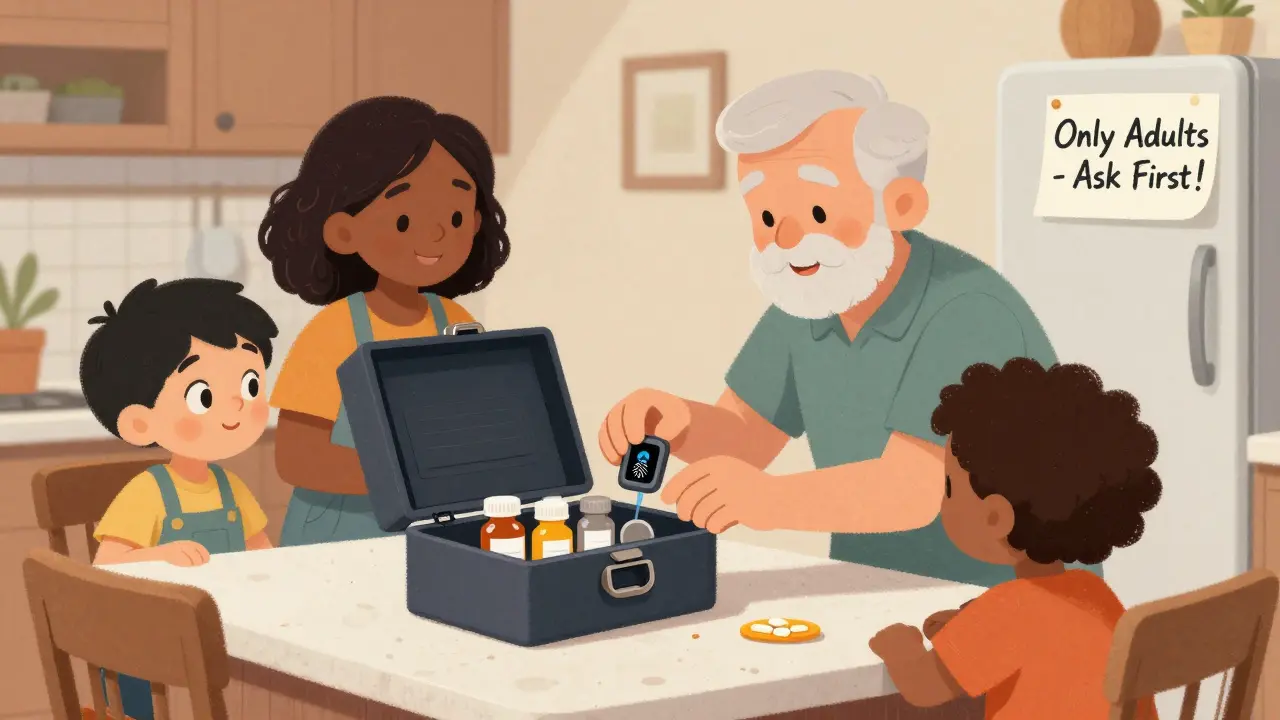
What About Disposal?
Lockboxes keep meds safe - but they don’t dispose of them. Never flush pills. Don’t throw them in the trash. Use a drug take-back program. Many pharmacies, police stations, and hospitals offer free disposal bins. In Alabama, you can drop off unused meds at any DEA-registered collector. Find one near you at DEA.gov/disposal. If no take-back is available, mix pills with coffee grounds or cat litter, seal them in a container, and throw them in the trash. Remove labels first. This isn’t ideal - but it’s better than leaving them out.Real Stories, Real Impact
One mother on Reddit said her 3-year-old climbed up to the medicine cabinet and pulled out a fentanyl patch. He had it on his skin for 20 minutes before she found him. After that, she bought a lockbox. “Eight months later, no incidents. No panic. Just peace,” she wrote. Another user, caring for her 80-year-old father, switched from a key lock to a fingerprint box after he spent 15 minutes trying to open it one night. “It cost $35 more,” she said. “Worth every penny.” The data backs this up. Households using lockboxes saw a 92% improvement in safe storage. In homes where lockboxes were distributed for free, 94% of users said they’d recommend them.It’s Not Just About Kids
Lockboxes aren’t just for children. Teens are the second biggest risk group. Studies show that 1 in 5 teens who misuse prescription opioids get them from home. Friends come over. They see the bottle. They think it’s harmless. A lockbox stops that before it starts. It also protects against theft. People steal pain meds for resale. If your meds are locked up, they’re not easy targets. And if you’re the one taking the meds? A lockbox helps you stay on track. No more double-dosing because you forgot you already took it.Final Thought: This Is a Simple Fix for a Deadly Problem
You don’t need to be an expert. You don’t need to spend hundreds. You just need to act. A $25 lockbox, mounted on a wall, with a simple code only two people know - that’s all it takes to prevent a tragedy. The opioid crisis didn’t start overnight. And it won’t end overnight. But every locked box is a small victory. One less child in the ER. One less teen addicted. One less parent burying their child. Start today. Check your medicine cabinet. Pull out the high-risk pills. Get a lockbox. Install it. Tell your family. Sleep better.What medications absolutely need to be locked up?
Any prescription opioid (like oxycodone, hydrocodone, fentanyl), benzodiazepine (like Xanax, Valium), or stimulant (like Adderall, Ritalin). Even some sleep aids and muscle relaxants. If the label says "controlled substance" or has a C-II to C-IV classification, lock it up.
Are child-resistant caps enough?
No. Studies show 50% of children aged 4-5 can open them in under a minute. Lockboxes are the only reliable way to prevent access - no matter how clever or determined the child is.
Can I use a regular safe or gun safe for meds?
Yes - if it’s secure and accessible only to adults. But most gun safes are too big, heavy, or hard to open quickly for daily use. A dedicated medication lockbox is designed for easy, daily access without compromising safety.
Where can I get a free medication lockbox?
At least 22 U.S. states offer free lockboxes through public health programs. Check with your local health department, hospital, or pharmacy. In Alabama, many clinics give them out at no cost. You can also ask your doctor - many have them on hand.
What if I forget the combination?
Most lockboxes have a reset procedure - check the manual. If you’re locked out, some models have a master override key. Never write the code on the box. Store it separately - in your phone, wallet, or with a trusted family member.
Do I need a lockbox if I don’t have kids?
Yes. Teens, visitors, houseguests, or even yourself can accidentally misuse meds. Overdoses from shared or forgotten pills are common. Lockboxes protect everyone - not just children.
How do I dispose of old or unused meds?
Never flush or throw pills in the trash. Use a drug take-back program at a pharmacy, hospital, or police station. In Alabama, DEA-registered collectors are available in most cities. Find one at DEA.gov/disposal. If none are nearby, mix pills with coffee grounds or cat litter, seal in a container, and throw away - after removing labels.



14 Comments
Yeah right, lockboxes are gonna solve the opioid crisis? Meanwhile, the FDA approves new painkillers every month and pharmacies sell them like candy. You think a $25 box stops a determined teen? Nah. It just makes parents feel better while the real problem - corporate greed and lazy prescribing - keeps going. This is virtue signaling with steel.
lockbox?? lmao my nan keeps her xanax in a biscuit tin under the bed. she forgets shes even got em. but hey, if u wanna spend £40 on a tin with a code, go nuts. my mum says its ‘overkill’ 😂
Let’s break this down statistically. 60k ER visits annually? That’s 0.018% of U.S. children. Meanwhile, 1.7 million kids are in foster care due to parental neglect - and nobody’s talking about locking up *parents*. The real issue is systemic failure, not pill containers. This article is a distraction dressed in safety gear.
Also, biometric locks? You’re telling me a 3-year-old can’t just smash a $60 box with a hammer? Steel doesn’t fix parenting. It just adds a line item to your Amazon cart.
wait so if i have adderall for adhd and my little cousin visits every weekend… i gotta lock it? even tho i take it daily and it’s in the original bottle? what if i forget the code and need it at 2am? this feels like overkill… but also… maybe not? idk
Lockboxes aren’t optional. They’re baseline. I’m a security pro. I’ve seen homes with gun safes full of opioids. That’s not safety - that’s a liability waiting for a party. Mount it. Set a code. Don’t tell the babysitter. Done. Simple. Effective. No drama.
While the intent of this guide is commendable, it lacks cultural nuance. In many households across the U.S., medication is shared among family members as a form of mutual care. The assumption that all users are nuclear-family-centric may alienate extended or multigenerational homes. A more inclusive approach would acknowledge alternative safety protocols.
This is an excellent, well-researched guide. I am from India, where access to prescription medications is often unregulated, and misuse is rampant. The concept of a lockbox is not common here, but it should be. I will share this with my family doctor. Thank you for the clarity on C-II to C-IV classifications - that alone is worth the read.
my sister’s boyfriend stole her xanax last year… then he OD’d. she cried for a week. now she has a biometric box. 🤍 it’s like a mini safe for her sanity. also, she put a sticker on it that says ‘DO NOT TOUCH OR I WILL CRY AGAIN’ 😭
Child-resistant caps fail 50% of the time? Source? CDC? AAP? Name the study. Also, 72% of kids find hidden stashes? Where’s the data? This reads like fear-mongering dressed as public health advice.
Let’s be real - if your kid is climbing shelves to get your Xanax, you’ve already lost. Lockboxes are the Band-Aid on a bullet wound. Meanwhile, your 16-year-old is getting Adderall from the school drug dealer who buys it from your cousin’s ex. This article treats symptoms like they’re the disease. Pathetic.
i got a lockbox after my niece tried to take my dad’s pain pills. it was scary. now it’s just… there. on the closet shelf. no one touches it. i feel better. thats all
you know who’s really behind this? Big Pharma. They want you to buy lockboxes so they can sell you more pills later. They know if you lock them up, you’ll forget you need them… and then you’ll call your doctor for more. It’s a trap. I’ve seen the documents. They’re watching you. 🕵️♀️
For insulin or refrigerated meds, you need a climate-controlled lockbox - that’s critical. Most people don’t realize regular boxes can ruin biologics. Also, if you’re on opioids, keep a log of doses. Even if it’s just a sticky note. Helps avoid accidental double-dosing. And yes - lock it. Even if you’re ‘responsible.’
Ah yes, the modern West’s solution to moral decay: a metal box. You lock your pills, but not your children’s boredom. You lock your Xanax, but not your social media addiction. You lock your medicine cabinet, but not your existential dread. How poetic. A lockbox for pills, and a void for purpose.