
Vitamin K Intake Calculator
Track Your Vitamin K Intake
Enter your daily food servings to calculate your vitamin K intake and see how it affects your warfarin therapy.
Your Vitamin K Intake
Total vitamin K: 0 mcg
Consistency: Safe
Consistent vitamin K intake helps maintain stable INR levels. Aim for the same amount daily.
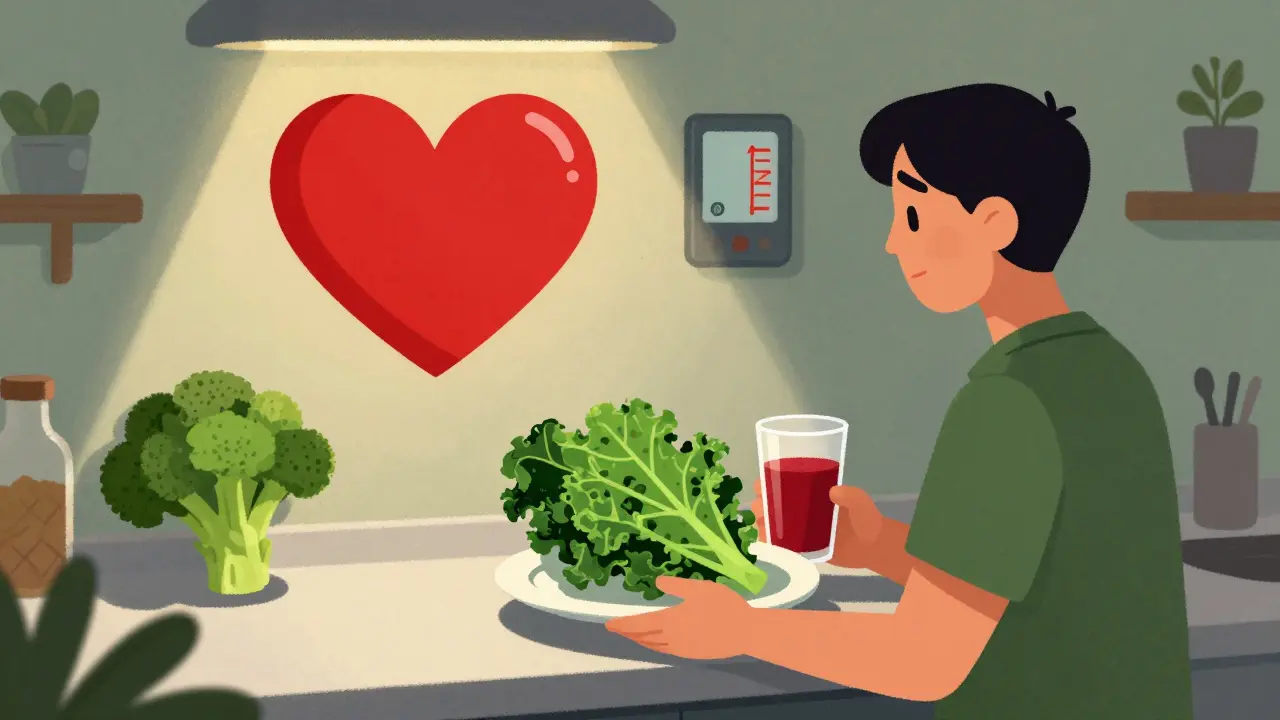
When you're on warfarin, what you eat isn't just about nutrition-it can mean the difference between a clot forming and a dangerous bleed. This isn't theoretical. People on warfarin have ended up in the ER because they ate a big bowl of kale one day and then skipped greens the next. Or drank cranberry juice thinking it was healthy, only to find their INR sky-high. The truth? You don't have to give up your favorite foods. You just need to be consistent.
How Warfarin Works (And Why Food Matters)
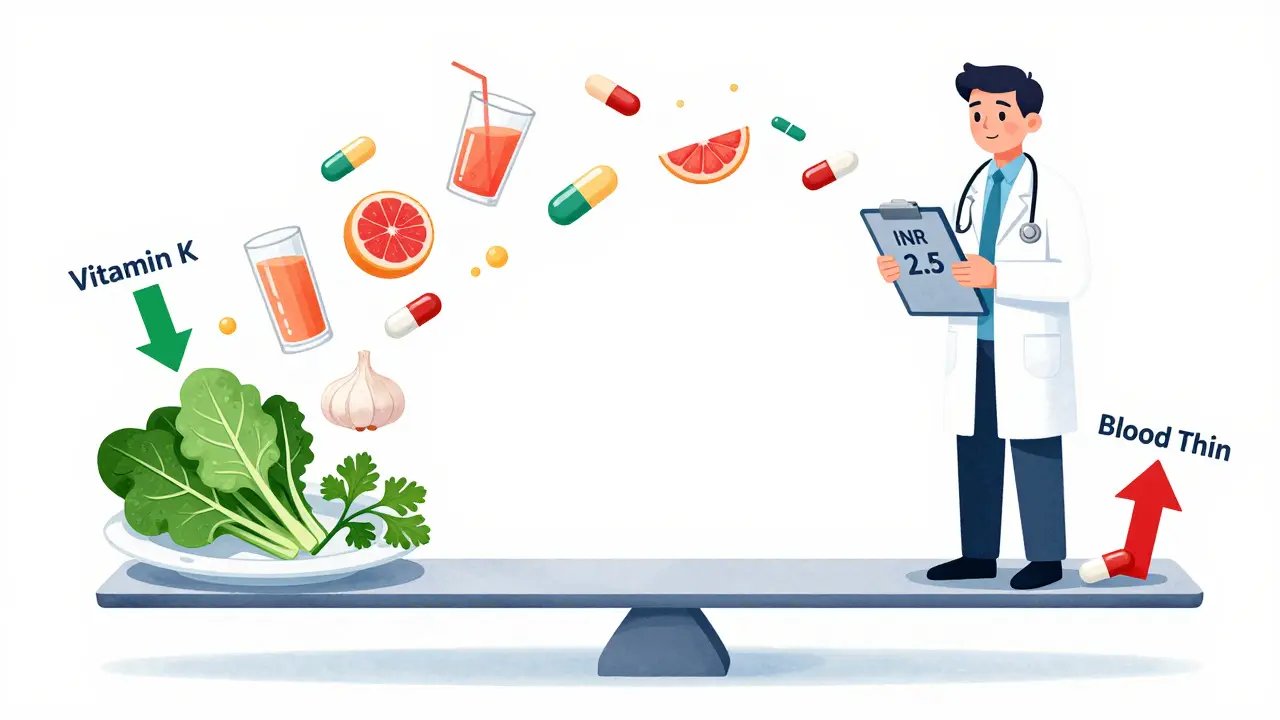
Warfarin, sold under brands like Coumadin and Jantoven, keeps your blood from clotting too easily. It does this by blocking vitamin K, a nutrient your body needs to make clotting factors. Think of it like a seesaw: too much vitamin K from food lowers warfarin’s effect. Too little makes it too strong. Your doctor checks this balance with a blood test called INR. The goal? Keep it between 2.0 and 3.0 for most people. If it drops below 2.0, clots can form. If it goes above 3.5, you risk bleeding inside your brain, gut, or joints.
The problem isn’t vitamin K itself-it’s inconsistency. One day you eat spinach salad. The next, you eat pasta. That swing throws your INR off. A single cup of cooked spinach has nearly 900 micrograms of vitamin K. That’s more than 10 times your daily need. If you’re used to eating low-vitamin K foods and suddenly eat that, your INR can drop by 0.5 to 1.0 within just a few days. That’s enough to make your doctor change your dose-or worse, send you to the hospital.
The Complete Food List: What to Watch Out For
Not all foods affect warfarin the same way. Here’s a clear breakdown based on vitamin K content, using data from the British Columbia Ministry of Health and the University of Iowa Hospitals.
Very High Vitamin K Foods (Over 500 mcg per 100g)
- Kale (817 mcg)
- Collard greens (623 mcg)
- Parsley (616 mcg)
- Seaweed (599 mcg)
- Spinach (483 mcg)
- Swiss chard (450 mcg)
- Turnip greens (421 mcg)
High Vitamin K Foods (100-500 mcg per 100g)
- Broccoli (raw, 102 mcg)
- Brussels sprouts (177 mcg)
- Green tea (106 mcg)
- Asparagus (cooked, 70 mcg)
- Cabbage (cooked, 60 mcg)
- Green beans (45 mcg)
Medium Vitamin K Foods (25-100 mcg per 100g)
- Lettuce (raw, 30 mcg)
- Carrots (13 mcg)
- Potatoes (2 mcg)
- Apples (4 mcg)
- Chicken (1 mcg)
- Rice (1 mcg)
Notice something? You don’t have to avoid these foods. You just need to eat the same amount every day. If you normally eat half a cup of cooked broccoli three times a week, keep doing that. Don’t double it because you’re feeling healthy. Don’t skip it because you’re tired of it. Consistency is your best tool.
Other Foods and Drinks That Interfere
Vitamin K isn’t the only player. Other foods and drinks can change how your body breaks down warfarin, and they’re just as dangerous.
Cranberry juice is a silent killer. It blocks the liver enzyme that breaks down warfarin. One study found that daily cranberry juice raised INR by 1.0 to 2.0 units-enough to push someone from safe to dangerous in days. One Reddit user went from INR 2.4 to 4.1 after drinking 8 ounces daily. That’s a major bleeding risk. Avoid it completely.
Grapefruit juice does something similar. It slows down the enzyme CYP3A4, making warfarin build up in your blood. People who drank grapefruit juice regularly saw their INR jump by 0.8 to 1.5. One study showed a 30% increase in bleeding risk. Skip it. Even one glass a day can cause problems.
Alcohol is tricky. A drink or two occasionally? Usually fine. But more than three drinks a day? That lowers warfarin’s effect by 15-20%. Why? Alcohol speeds up how fast your liver clears the drug. If you drink heavily on weekends and then stop on Monday, your INR will swing wildly. The rule: no more than two drinks per day, and at least two alcohol-free days each week.
Supplements That Can Be Dangerous
Just because something’s labeled “natural” doesn’t mean it’s safe with warfarin.
- Fish oil (omega-3): Increases bleeding risk by 25%. If you take it for heart health, talk to your doctor. You might need to stop or reduce the dose.
- Garlic supplements: Can raise INR by 0.8 to 1.2 units. Fresh garlic in cooking? Fine. Pills? Not worth the risk.
- Ginkgo biloba: Linked to serious bleeding in case reports. Even small doses can be dangerous.
- Green tea extract: The supplement form is concentrated. A cup of brewed tea is okay, but pills? Avoid.
- Vitamin E: High doses (over 400 IU) can thin your blood further. Stick to what’s in your multivitamin.
Always tell your anticoagulation clinic about any supplement you take-even if you think it’s harmless. A 2023 study found that 41% of warfarin patients didn’t mention supplements to their doctors because they assumed they were safe.
Real-Life Strategies That Work
People who stay stable on warfarin don’t do it by accident. They build habits.
One man on Reddit, u/StableINR, kept his INR in range for 18 months by eating exactly one cup of spinach salad every day. Same amount. Same time. Same day. No variation. That’s the secret.
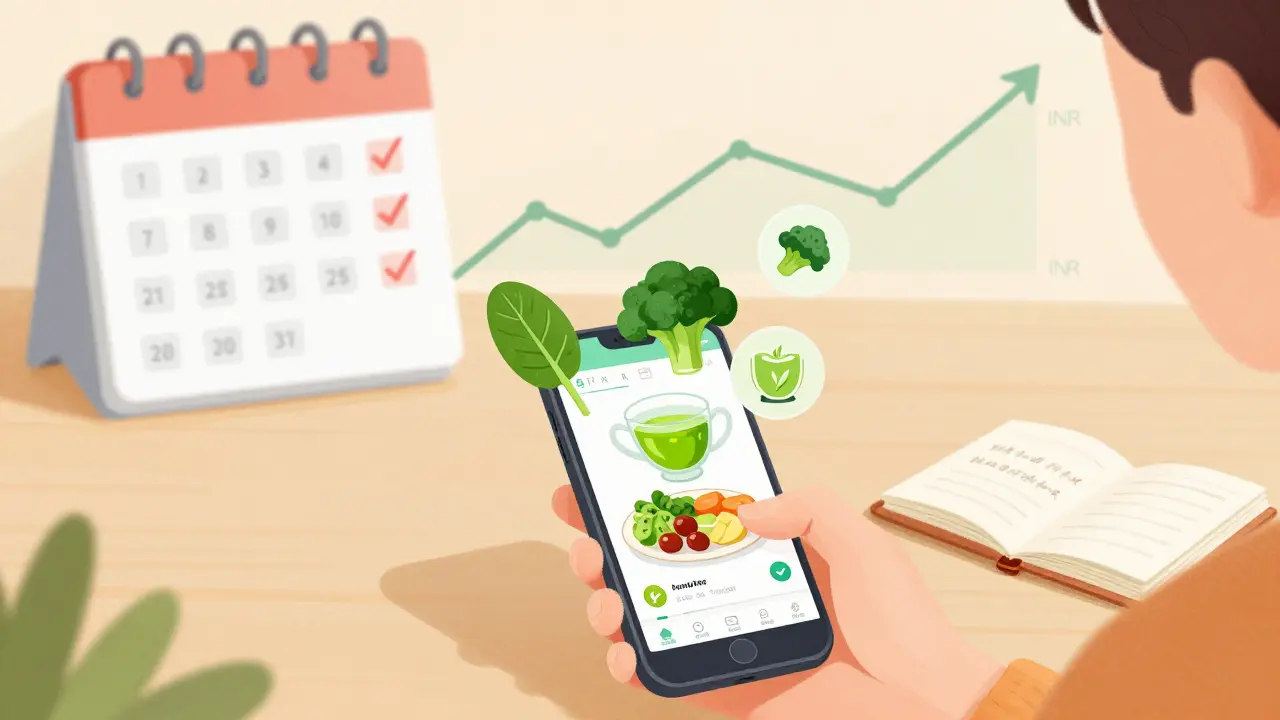
Another approach? Use a food tracking app. MyFitnessPal lets you log vitamin K intake. A 2022 study found that people who tracked their meals had 22% fewer out-of-range INR tests. You don’t need to count every microgram. Just notice patterns. If your INR dropped after eating a lot of kale, you’ll know to keep it steady next week.
Keep a simple food journal. Write down:
- What you ate (especially greens, broccoli, cabbage)
- Any juice or alcohol
- Any new supplement
- Your INR result
Bring this to your appointments. Doctors can spot trends you miss. A 2023 survey from the American Thrombosis Association found that people who kept food journals spent 76% of their time in the safe INR range. Those who didn’t? Only 48%.
What to Do If You Accidentally Eat Something Risky
Everyone slips up. You go to a friend’s house and they serve a kale salad. Or you grab a cranberry smoothie without thinking. What now?
Don’t panic. Don’t skip your next warfarin dose. Don’t try to “fix” it with more or less medication.
Instead:
- Write down what you ate and when.
- Call your anticoagulation clinic. They’ll tell you if you need an INR test sooner.
- Go back to your normal routine the next day. Don’t overcorrect.
One bad meal won’t ruin your therapy. But if you keep doing it, you’ll end up with unstable INRs-and that’s when problems happen.
Warning Signs You Need Help Right Away
Warfarin can save your life. But if things go wrong, it can be deadly. Know the red flags:
- Bleeding that won’t stop after 5 minutes (like from a cut or nosebleed)
- Black, tarry, or bloody stools
- Red or pink urine
- Severe headache, dizziness, or confusion (could mean bleeding in the brain)
- Unexplained bruising or swelling
- Sharp pain in your chest, abdomen, or joints
If you have any of these, go to the ER or call emergency services. Don’t wait. These signs showed up in 18% of warfarin-related ER visits, according to CDC data.
Why Warfarin Is Still Used (And When It’s Best)
You might hear about newer blood thinners like Eliquis or Xarelto. They don’t need diet changes or regular blood tests. So why is warfarin still the top choice for 250,000 Americans with mechanical heart valves?
Because for certain conditions, nothing works better. Warfarin is the only drug proven to protect mechanical valves from clots. It’s also cheaper-about $10 a month versus $500 for a DOAC. In places with limited healthcare access, it’s often the only option.
But here’s the catch: if you can’t stick to a consistent diet, or if you forget to get your INR checked, DOACs might be safer for you. Talk to your doctor. It’s not about being “better.” It’s about what works for your life.
Final Advice: Keep It Simple
You don’t need to become a nutritionist. You don’t need to memorize every food’s vitamin K level. Just follow three rules:
- Be consistent. Eat the same amount of vitamin K every day. If you like spinach, have it regularly. If you don’t, skip it.
- Avoid cranberry juice, grapefruit juice, and alcohol beyond 2 drinks a day. These are non-negotiable.
- Talk to your anticoagulation team before taking anything new. Supplements, herbs, even over-the-counter painkillers can interfere.
Staying on warfarin isn’t about restriction. It’s about rhythm. Find your routine. Stick to it. And you’ll live a full, safe life.


10 Comments
Let’s be real-warfarin isn’t some magic bullet, it’s a high-wire act with spinach as the tightrope. The vitamin K consistency thing? Absolute gospel. I’ve seen guys go from INR 2.1 to 4.8 because they went from ‘no greens’ to ‘kale smoothie for breakfast’ like it’s a wellness trend. It’s not about restriction, it’s about rhythm. Your body craves predictability like a cat craves sunbeams. One cup spinach, every damn day. No more, no less. That’s the ritual. That’s the safety net.
There’s something deeply human about this. We want to fix things with extremes-either ban kale entirely or binge it like it’s the last meal on Earth. But stability? It’s quiet. It’s the same bowl of broccoli every Tuesday and Thursday. No fanfare. No detox. Just consistency. I’ve been on warfarin for 7 years. My secret? I eat the same lunch every day. Not because I’m boring, but because my INR likes routine. And hey-if your liver could talk, it’d probably thank you for not switching up the vitamin K like a DJ at a rave. 🙏
Okay, but let’s unpack this a little deeper, because the entire premise here is dangerously oversimplified. Vitamin K isn’t the only variable-genetic polymorphisms in VKORC1 and CYP2C9 account for up to 30% of warfarin dose variability, and yet nobody’s talking about pharmacogenomics. You’re telling people to eat consistent greens but ignoring that someone with a VKORC1 -1639GG genotype might need 5mg/day while a CC homozygote needs 7mg just to hit the same INR. And then there’s the gut microbiome! Recent studies show that gut bacteria metabolize vitamin K and can alter bioavailability. So telling someone to ‘just eat the same amount’ ignores the fact that their microbiome might be changing due to antibiotics, stress, or even a new probiotic. This advice is like telling someone with diabetes to ‘just eat less sugar’ without mentioning insulin resistance, beta-cell function, or hepatic glucose output. It’s not just incomplete-it’s dangerously reductive. And don’t even get me started on how the article conflates correlation with causation regarding cranberry juice. The 2005 study that started this myth was a case series of 3 patients. That’s not evidence, that’s an anecdote dressed up as a public health warning.
Wow. Just wow. This is the most patronizing, fear-mongering, nutritionist-tier nonsense I’ve read since the 90s ‘fat is evil’ craze. You’re treating adults like toddlers who can’t handle a salad. ‘Don’t eat kale unless you eat it the same amount every day’? What’s next? ‘Don’t breathe unless you inhale exactly 4.2 liters per minute’? And cranberry juice? The same juice that’s been consumed for centuries by indigenous peoples and now it’s a ‘silent killer’? This isn’t medicine, it’s cultish control disguised as safety. You’re not helping people-you’re turning them into anxious food police. And don’t even get me started on the ‘keep a journal’ nonsense. You think people on warfarin don’t already have enough to manage? This post is a masterpiece of medical gaslighting.
The content presented is largely accurate and aligns with current clinical guidelines from the American College of Chest Physicians and the American Heart Association. However, the casual tone and colloquial phrasing undermine the gravity of anticoagulation management. For example, referring to cranberry juice as a 'silent killer' is hyperbolic and unscientific. While clinically significant interactions have been documented, they are rare and typically occur with chronic, high-volume consumption. Additionally, the assertion that 'one bad meal won't ruin your therapy' is misleading; a single large dose of vitamin K can precipitate a rapid INR drop, particularly in patients with low baseline intake. Precision in language is not pedantry-it is patient safety. This post should be revised to reflect the rigor expected in clinical communication.
Big respect to the author-this is the kind of info that actually saves lives. I’ve been on warfarin for 6 years, and my INR used to swing like a pendulum until I started eating the same greens every day. No drama. No stress. Just one cup of spinach with breakfast, Monday through Sunday. And yeah, I stopped the cranberry juice. Not because I’m scared-I just don’t miss it. Grapefruit juice? Gone. Alcohol? Two drinks max, and never on the day before my INR check. The food journal? Changed everything. I use MyFitnessPal now. It’s not perfect, but it shows me patterns. I used to think this stuff was overkill. Turns out, it’s the only thing keeping me alive. 🙌
Of course the author is going to downplay the risks of supplements. They didn’t mention turmeric. Turmeric. Curcumin. That stuff increases bleeding risk by 40% in some studies. And you think people are going to read this and say ‘oh, I’ll just stop my fish oil’? No. They’ll keep taking it because ‘it’s natural’ and then show up in the ER with a subdural hemorrhage. And what about St. John’s Wort? It induces CYP3A4 and CYP2C9-drops warfarin levels like a rock. But nope, not even a footnote. This article is dangerously incomplete. It’s not just cranberry juice and kale-it’s every damn supplement, herb, and ‘natural remedy’ sold at Whole Foods. And people are dying because of this watered-down advice. You’re not helping. You’re enabling.
How quaint. We have reduced the complex pharmacodynamics of vitamin K antagonism to a dietary mantra: ‘eat the same spinach every day.’ This is the apotheosis of neoliberal health ideology-blaming the individual for systemic failures in pharmacological precision. Why not just give everyone a DOAC and be done with it? Because the market doesn’t incentivize it. Warfarin persists not because it’s superior, but because it’s cheap-and we’ve outsourced the burden of compliance to the patient’s grocery cart. The real tragedy isn’t the kale salad-it’s that we’ve turned anticoagulation into a moral performance. You’re not ‘bad’ if your INR spikes. You’re just a cog in a broken system. And yet, here we are, lecturing people about consistency like it’s a virtue, not a consequence of structural neglect.