
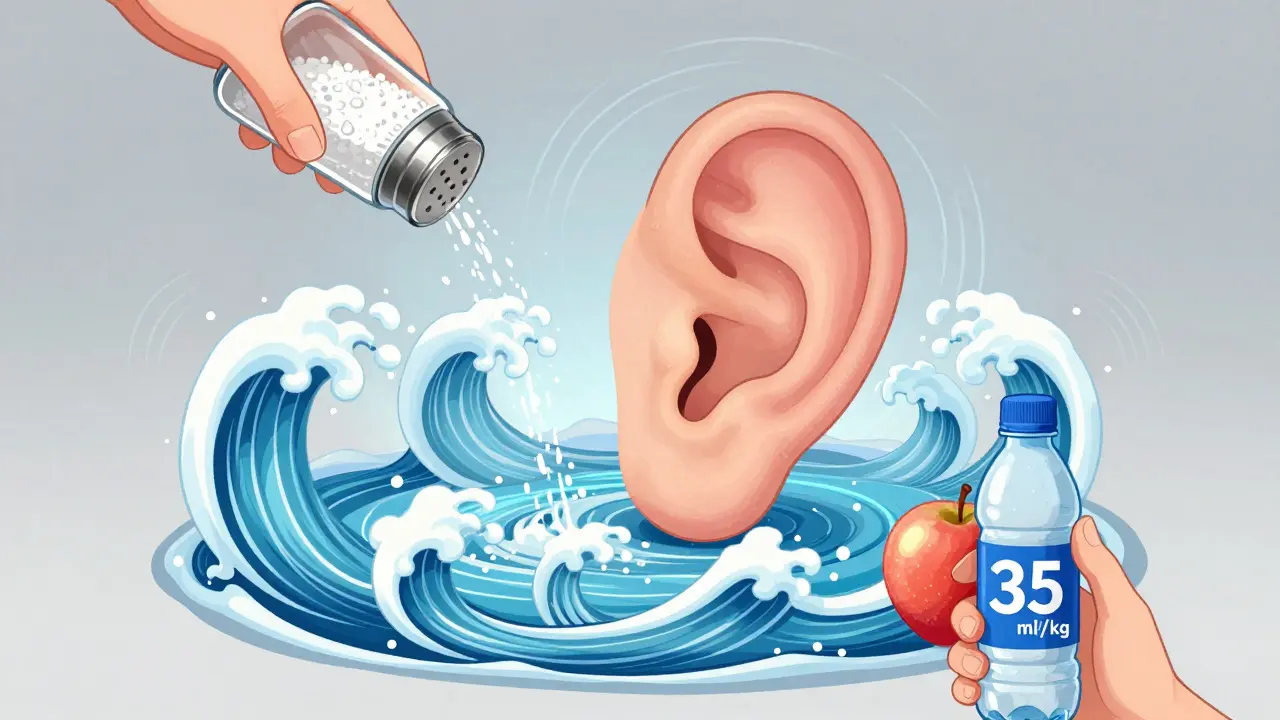
When you feel the room spin out of control, your ear rings like a broken alarm, and your hearing suddenly mutes - it’s not just bad luck. It’s Meniere’s disease. And while there’s no cure, the most powerful tool most doctors give you isn’t a pill. It’s your fork.
Why Your Salt Shaker Is Your Worst Enemy
Meniere’s disease attacks the inner ear, flooding it with too much fluid. That fluid buildup causes pressure, which messes with your balance, hearing, and sound processing. The result? Vertigo attacks that can last hours, muffled hearing that comes and goes, and tinnitus that never shuts up.The problem isn’t just water. It’s sodium. Salt pulls water into your body - including into your inner ear. Every teaspoon of salt you eat holds about 2,300 mg of sodium. That’s the upper limit for healthy adults. For someone with Meniere’s, it’s too much. Too much salt means too much fluid trapped in your ear. And that’s what triggers the attacks.
Doctors have known this since the 1920s. Back then, they noticed patients felt better when they ate less salt. Now, decades later, research confirms it. A 2024 study of 50 people with stage-3 Meniere’s showed that cutting sodium to 1,500 mg per day - half the average American intake - led to a 12.3 dB improvement in hearing, a 40% drop in vertigo frequency, and tinnitus that became noticeably quieter.
That’s not a small win. That’s life-changing.
The 1,500 mg Rule: What It Really Means
Most guidelines say to aim for 1,500 to 2,000 mg of sodium a day. But 1,500 mg is the sweet spot. It’s not a suggestion. It’s a target. And it’s harder than you think.One slice of bread? 230 mg. A can of soup? 800 mg. A handful of pretzels? 300 mg. A restaurant chicken sandwich? Over 1,500 mg - and that’s before the fries.
You’re not fighting salt at the table. You’re fighting it in processed food. Seventy-seven percent of the sodium in the average diet comes from packaged, canned, frozen, or restaurant meals. Not from the shaker.
So here’s what you actually do:
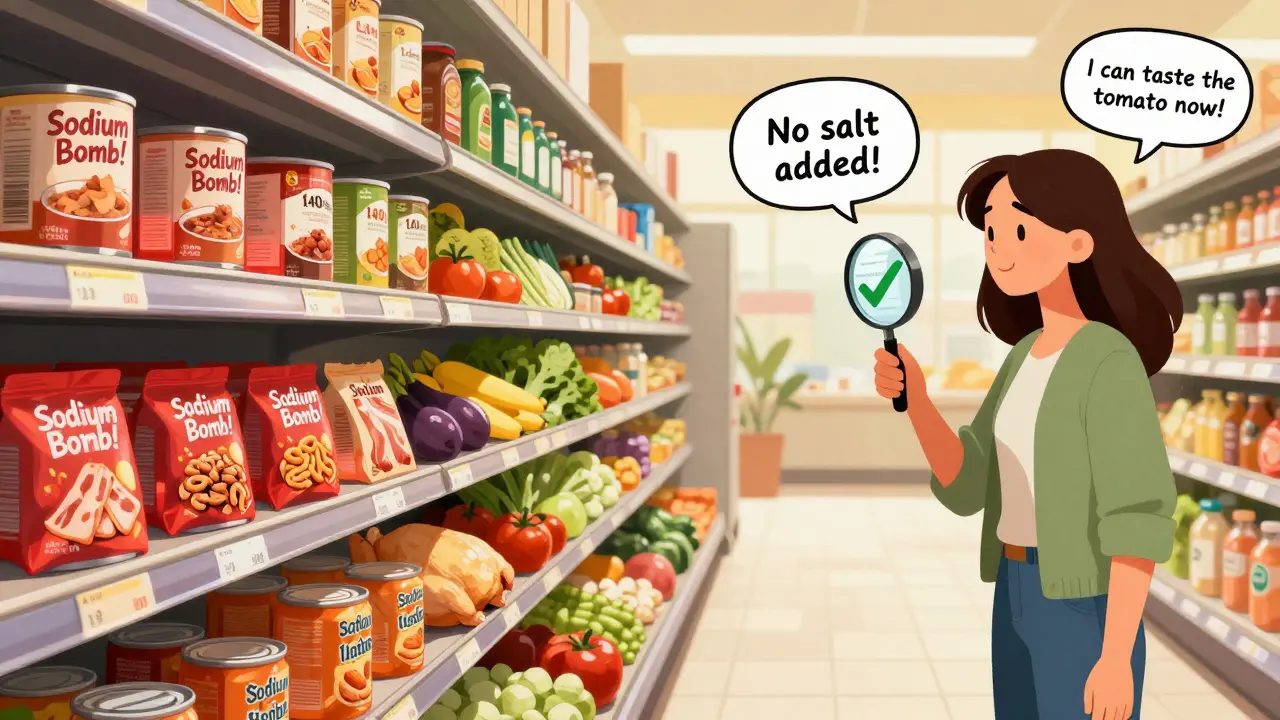
- Stop buying canned vegetables, soups, and beans unless they say “no salt added.”
- Avoid deli meats, bacon, sausage, and smoked fish - all loaded with salt for preservation.
- Ditch the soy sauce, ketchup, mustard, and Worcestershire sauce. Even “low sodium” versions often have 300-500 mg per tablespoon.
- Don’t eat fast food. Period. A single burger and fries can blow your entire daily limit.
- Shop the perimeter of the grocery store: fresh produce, plain meats, eggs, unsalted nuts, oats, rice, potatoes.
- Read labels. Look at the “Sodium” line on the nutrition facts. If it’s over 140 mg per serving, skip it - unless you’re planning to eat only half a serving.
And here’s the trick: spread your sodium intake. Don’t eat all your allowed salt in one meal. If you have a low-sodium lunch, don’t save your sodium for dinner. Keep it even.
Drink More Water - But Not Too Much
You’ve heard “drink eight glasses a day.” That’s not the rule for Meniere’s. In fact, drinking too much water can make things worse.What you need is balance. The 2024 study that showed big improvements in hearing and vertigo didn’t just cut salt. It also told people to drink exactly 35 milliliters of water per kilogram of body weight every day.
That’s not eight glasses. That’s:
- For a 70 kg (154 lb) person: 2.45 liters (about 10 cups)
- For a 90 kg (198 lb) person: 3.15 liters (about 13 cups)
Why this number? Because your body needs steady hydration to flush out excess fluid - but not so much that it overwhelms your inner ear. Dehydration makes your body hold onto water. Too much water floods it. The 35 ml/kg rule is the Goldilocks zone.
Drink water. Don’t chug it. Sip it all day. Skip the soda, coffee, and alcohol. Caffeine and alcohol constrict blood vessels in your inner ear, making fluid buildup worse. They’re not just empty calories - they’re triggers.
What You Can Eat (And What You Can’t)
Here’s a simple guide to what fits in a Meniere’s-friendly diet:| Good Choices | Bad Choices |
|---|---|
| Fresh fruits and vegetables | Canned vegetables (unless no salt added) |
| Plain chicken, fish, beef, tofu | Packaged deli meats, bacon, ham |
| Unsalted nuts, seeds | Pre-seasoned or salted nuts |
| White rice, quinoa, oats | Instant rice, flavored rice mixes |
| Homemade broth (no salt) | Store-bought broth, bouillon cubes |
| Herbs, lemon, vinegar, garlic, pepper | Soy sauce, ketchup, mustard, relish |
| Plain yogurt (unsweetened) | Flavored yogurts, processed cheese |
Seasoning doesn’t have to mean salt. Try smoked paprika, cumin, turmeric, rosemary, or citrus zest. A squeeze of lemon on grilled fish tastes better than salt anyway.
Why This Works - Even Without a Cure
Some people think dietary changes are just “old wives’ tales.” But the science is clear. The inner ear doesn’t care about your beliefs. It responds to sodium and fluid pressure.When you lower sodium, your body releases less aldosterone - a hormone that tells your kidneys to hold onto salt and water. Less aldosterone means less fluid builds up in your inner ear. That’s why vertigo attacks drop. That’s why your hearing improves. That’s why the ringing fades.
One study found 68% of people who stuck to under 3,000 mg of sodium a day saw major symptom improvement - without any drugs. That’s better than most medications.
Compare that to diuretics like hydrochlorothiazide. They help about half of patients, but they can cause dizziness, muscle cramps, and kidney stones. And you have to take them every day. Salt restriction? No side effects. No prescriptions. Just food choices.
The Hard Truth: Why Most People Fail
This isn’t a quick fix. It’s a lifestyle shift. And it’s hard.One study found 22% of people gave up on the diet because food tasted bland. Others couldn’t handle eating differently at parties or restaurants. Social pressure is real. You’ll get asked, “Why are you not eating the salad dressing?” or “Just one bite won’t hurt.”
But here’s what no one tells you: the first two weeks are brutal. Your taste buds are used to salt. They’ll scream for it. But after 30 days, they reset. Food starts tasting richer. A tomato becomes sweet. A potato becomes earthy. You’ll start noticing flavors you forgot existed.
Plan ahead. Pack your own snacks. Bring your own dressing to potlucks. Ask restaurants to cook your meal without salt. Most chefs will do it - if you ask nicely.
And if you slip? Don’t quit. One high-sodium meal won’t ruin you. But two in a week? That’s when the vertigo comes back.
What Comes Next?
Diet isn’t the only tool. Some people need diuretics. Others get steroid injections into the ear. But those are backups. The foundation? Your plate.The National Institutes of Health is running a major trial right now - enrolling 300 people to compare 1,500 mg vs. 2,300 mg sodium limits over 12 months. Results won’t be out until late 2025. But the early data is already telling us: lower sodium = better outcomes.
And if you’re reading this, you’re already ahead. You’re not waiting for a miracle drug. You’re taking control.
Start today. Read one label. Swap one processed snack for an apple. Drink your 35 ml/kg of water. Track your sodium for a week. You might be surprised how much better you feel - not in months, but in weeks.
Your ears are listening. So should you.
Can I ever eat salt again with Meniere’s disease?
You can, but you shouldn’t. Even small amounts of sodium can trigger fluid buildup in your inner ear. Most people with Meniere’s need to stay under 1,500-2,000 mg per day for life. Occasional slips won’t destroy your progress, but regular salt intake will bring back vertigo and hearing loss. Think of it like diabetes - you manage it daily, not just when you feel bad.
Is a low-sodium diet the same as a keto or paleo diet?
No. Keto and paleo focus on carbs or processed foods, but they often include high-sodium items like bacon, cheese, and canned meats. A Meniere’s diet is about sodium and fluid balance, not macronutrients. You can follow a low-sodium version of keto or paleo, but you must actively avoid salt - even in “healthy” packaged foods.
How long does it take to see results from a low-sodium diet?
Most people notice fewer vertigo attacks within 2-4 weeks. Hearing improvements and reduced tinnitus often show up between 6-12 weeks. The 2024 study showed measurable hearing gains at 6 months. Don’t expect overnight results - but don’t give up before 30 days. Your inner ear needs time to rebalance.
Should I take a diuretic instead of changing my diet?
No - diet should come first. Diuretics like hydrochlorothiazide help about half of patients, but they cause side effects: dehydration, low potassium, dizziness, and kidney stones. A low-sodium diet works just as well - or better - with zero side effects. Doctors recommend diet before medication. Use pills only if diet alone doesn’t control symptoms after 3-6 months.
What about alcohol and caffeine?
Avoid them. Both constrict blood vessels in your inner ear, reducing blood flow and worsening fluid buildup. Even one glass of wine or cup of coffee can trigger vertigo or make tinnitus louder. If you must have caffeine, limit it to 100 mg per day (about half a cup of coffee) and never drink alcohol. The risk isn’t worth it.
Can children with Meniere’s follow the same diet?
Meniere’s is rare in children, but if diagnosed, the same principles apply: limit sodium, avoid processed foods, drink steady water. However, children need more calories and nutrients, so work with a pediatric dietitian to ensure they get enough protein, calcium, and vitamins while keeping sodium under 1,500 mg. Never restrict sodium in kids without medical supervision.


12 Comments
I switched to no-salt cooking last year after my first vertigo attack. At first, everything tasted like cardboard. Now? I notice the sweetness in roasted carrots and the earthiness in mushrooms. My tinnitus is 70% better. It’s not magic-it’s just listening to your body.
Also, lemon juice + smoked paprika on fish? Life-changing.
Low sodium works. I’ve been doing it for 18 months. No meds. No injections. Just food.
Still eat the occasional pretzel. Life’s too short to be perfect.
1,500 mg? That’s a joke. You’re telling people to eat like hospital patients. The real problem is stress and bad sleep, not salt. Your ‘study’ probably had a tiny sample size.
Also, water intake per kg? Who measures that? I just drink when I’m thirsty.
Respectfully, I find this article profoundly insightful. As a practitioner of Ayurvedic principles, I have long observed that fluid equilibrium in the body is paramount to inner ear health. The concept of sodium-induced hydrops aligns with the traditional understanding of Kapha imbalance. The recommendation of 35 ml/kg water intake mirrors the Ayurvedic emphasis on regulated, sipping hydration throughout the day, avoiding both excess and deficiency.
May I suggest also incorporating warm herbal infusions such as ginger or fennel to support lymphatic drainage? These have shown supportive results in my clinical experience.
Let’s be real-this isn’t just about salt. It’s about reclaiming your life from a disease that makes you feel like your own body is the enemy. I used to dread mornings because I never knew if I’d wake up to spinning walls and muffled silence. Now, after 11 months of sticking to this diet, I cook meals with my daughter, and she doesn’t even know I’m ‘on a diet.’ She just says, ‘Mom, why does everything taste so good?’
It’s not deprivation. It’s discovery. You start tasting the difference between salt and flavor. You realize food doesn’t need to scream to be loved. Your ears heal slowly, like a bruise fading under gentle hands. And when the ringing quiets down? You hear birds again. You hear your own breath. You hear yourself.
I didn’t just change my diet. I changed how I live. And for the first time in years, I’m not just surviving-I’m listening.
Don’t give up because it’s hard. Give up because you stopped caring. And if you’re still reading this? You haven’t given up yet. Keep going.
Wow. Another ‘diet cure’ for a neurological disorder. Next they’ll say yoga fixes Parkinson’s.
My neurologist told me this diet helps some people. Not all. And it’s not a replacement for meds if you’re Stage 3. Stop pretending this is a miracle. People are desperate. Don’t give them false hope wrapped in a Pinterest recipe.
Also, ‘drink 35ml/kg’? That’s 2.5 liters for a 130lb person. You’re telling people to chug water like it’s a detox cleanse? That’s dangerous. Hyponatremia is real.
The 2024 study cited is from the Journal of Otology and Neurotology. It was a prospective cohort with controlled dietary logs and audiometric testing-methodologically sound. The 12.3 dB improvement in hearing thresholds is statistically significant (p<0.01).
Also, the 35 ml/kg hydration protocol is based on total body water calculations for inner ear homeostasis. It’s not arbitrary. It’s physiology.
Yes, it’s hard. But so is living with constant vertigo.
So I’m supposed to give up soy sauce, ketchup, and wine… but I can still eat 2.45L of water a day? 😒
My inner ear is like a moody teenager: give it too much salt? It throws a tantrum. Give it too much water? It sulks and swells.
At least let me have one glass of wine. For science. And my sanity.
PS: I made roasted beets with thyme and apple cider vinegar last night. Tasted like a hug. Still crying over it.
THIS. RIGHT. HERE. 🙌
I’ve been living with Meniere’s for 7 years. Tried meds, injections, even vestibular rehab. Nothing worked like this. I started this diet 6 months ago. No more hospital visits. No more canceled plans. I’m hiking again. I’m cooking again. I’m living again.
Yes, it’s hard. Yes, it’s boring at first. But your taste buds? They adapt. Your ears? They thank you. And your future self? They’re doing a happy dance.
Start small. One meal. One label. One day. You’ve got this. 💪🌍
P.S. If you need meal ideas, DM me. I’ve got 127 low-sodium recipes. No salt. All flavor.
So basically you’re saying don’t eat anything tasty? I thought this was supposed to be about health, not punishment.
Also, why is everyone acting like this is new? My grandma did this in the 70s. She lived to 98. She also ate butter and bacon. So maybe it’s not the salt.
And who even measures water by kg? This sounds like a NASA protocol for astronauts, not a diet for regular people.
I used to think this was just ‘old people advice.’ Then I had my third vertigo attack in two weeks. I couldn’t hold my coffee. I couldn’t walk to the mailbox. I cried because I couldn’t hear my dog bark.
I tried this. Day 1: I hated everything. Day 7: I noticed the sweetness in my oatmeal. Day 21: I didn’t reach for salt. Day 45: I forgot I used to crave it.
My tinnitus? Gone during the day. Just a whisper at night.
This isn’t a diet. It’s a quiet revolution. And I’m not alone.
Brothers and sisters, I come from Nigeria where we love our soups and stews-loaded with salt, stock cubes, and flavor. But when my cousin was diagnosed with Meniere’s, we had to rethink everything.
We used fresh thyme, scotch bonnet, and smoked paprika. We made broth from chicken bones, simmered for hours, no salt. She cried the first time she tasted it-‘It tastes like home, but softer.’
Now she walks without holding the wall. Her hearing came back enough to hear her baby laugh.
This isn’t just science. It’s love. It’s choosing to live, even when your body feels broken. You are not alone. We are all in this together. 🌍❤️