
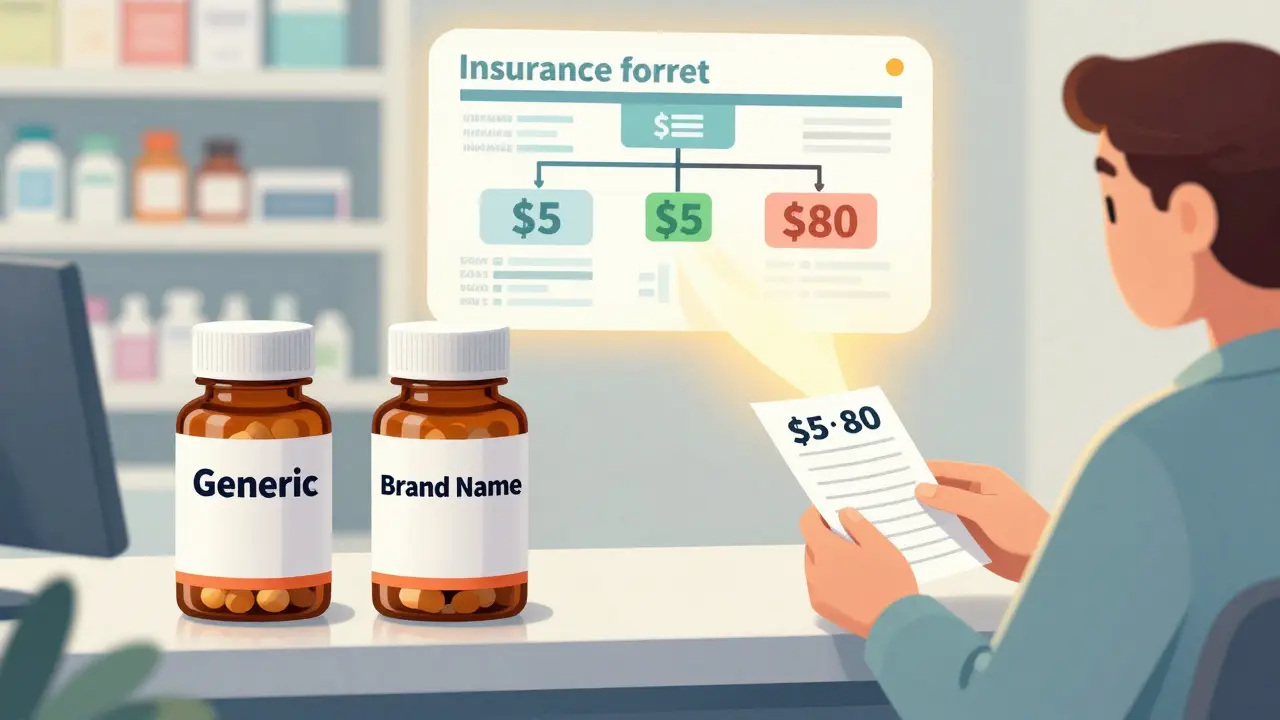
When you pick up a prescription, do you ever wonder why one drug costs $5 and another costs $80-even if they treat the same condition? The answer lies in how your insurance plan treats generic drugs versus brand-name drugs. These aren’t just price differences. They’re policy differences that can affect your health, your wallet, and even whether you fill your prescription at all.
How Insurance Formularies Work
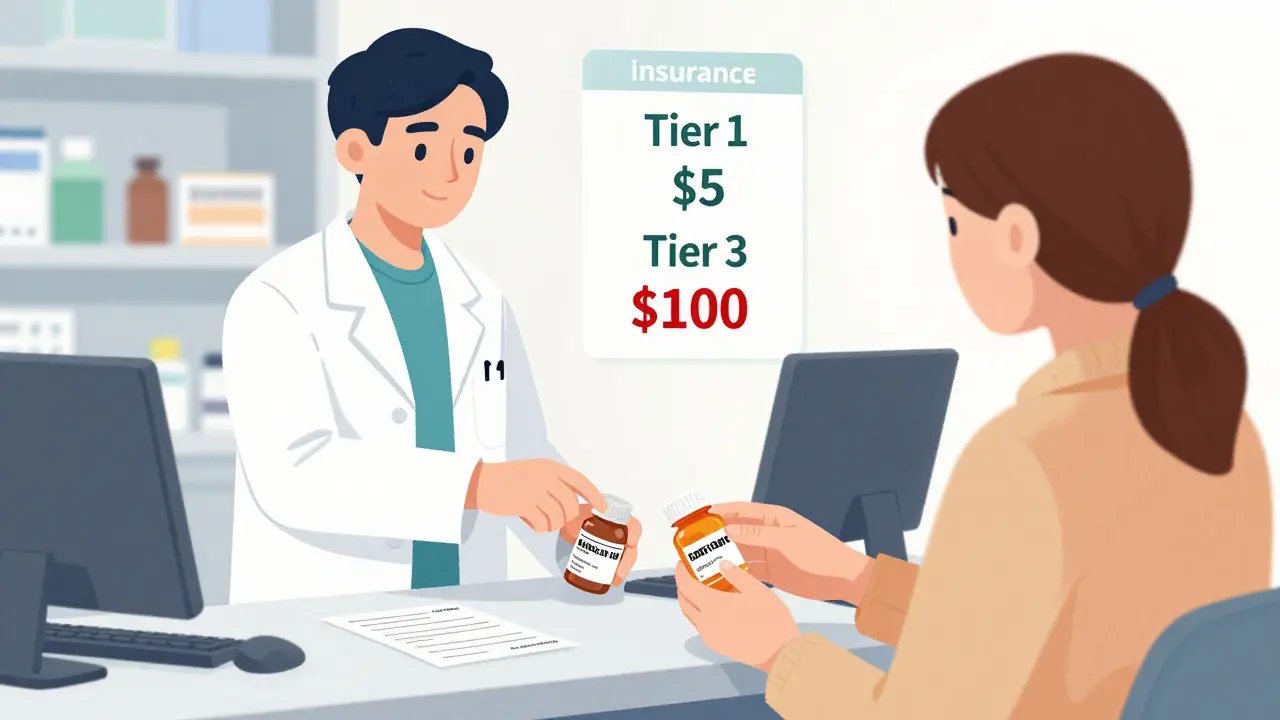
Most insurance plans use something called a formulary-a list of drugs they cover. This list isn’t random. It’s organized into tiers, and where a drug lands determines how much you pay. Generics almost always sit in Tier 1. That means a 30-day supply might cost you $5 to $15. Brand-name drugs? They’re usually in Tier 2 or 3. That’s $40 to $100 per prescription, or sometimes you pay a percentage of the total cost-like 25% to 33%.This tier system isn’t just about cost control. It’s a deliberate strategy. Insurance companies know generics work the same way as brand-name drugs. The FDA requires them to have the same active ingredients, strength, dosage, and effect. So why the price gap? Because generics don’t need to repeat expensive clinical trials. They copy an existing drug after the patent expires. That’s why they cost 80% to 85% less.
And insurers reward you for choosing generics. If a generic is available and you choose the brand, you don’t just pay the brand’s copay. You pay the generic copay plus the full difference between the brand and generic price. So if the brand costs $85 and the generic is $4, you pay $5 (the generic copay) plus $81-the rest of the brand’s cost. That’s not a mistake. It’s policy.
Automatic Substitution Rules
Here’s something most people don’t realize: your pharmacist can legally swap a brand-name drug for a generic without asking you-unless your doctor says not to. This is called substitution, and it’s allowed in all 50 states. In fact, 90% of all prescriptions filled in the U.S. are generics. That’s not because patients prefer them. It’s because the system pushes them.Insurance companies require pharmacists to substitute unless the prescriber writes "dispense as written" or "do not substitute" on the prescription. Some doctors do this routinely for certain drugs-like warfarin or levothyroxine-where even tiny differences in inactive ingredients can affect how the drug works. But for most medications, substitution happens automatically.
That’s why you might walk into the pharmacy for your blood pressure pill, leave with a different-looking tablet, and not even notice. Your insurer expects you to accept it. If you refuse, you pay more.
Medicare, Medicaid, and Commercial Plans-Big Differences
Not all insurance is the same. Medicare Part D plans are especially strict. They require pharmacists to substitute generics unless there’s a medical reason not to. In 2022, 91% of all Part D prescriptions were generics. That’s because Medicare has a "best price" rule: they pay the lowest price available to any private buyer. For generics, that’s often less than $10 per month. For brand-name drugs? Often double or triple.Medicaid works similarly but even more aggressively. Because states negotiate bulk prices, generic reimbursement rates are 87% lower than for brand-name drugs. That means Medicaid patients rarely pay more than a few dollars for generics-even if they have no other insurance.
Commercial plans (like those from Blue Cross or Aetna) are more complex. They often use step therapy-meaning you have to try the generic first. If it doesn’t work, you go through a process to get the brand. That process can take weeks. Some plans require three failed trials before approving the brand. For someone with chronic pain or depression, that’s not just a delay. It’s a health risk.
When Generics Don’t Work-And What You Can Do
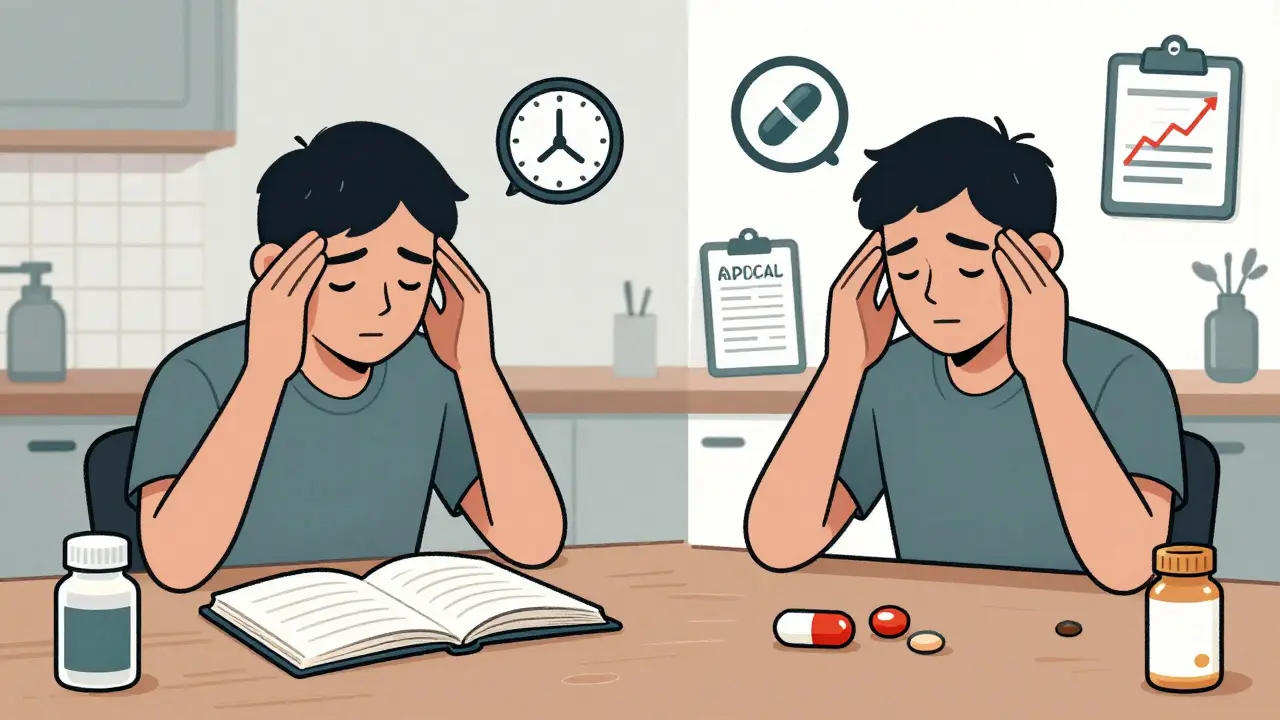
Let’s be real: for most people, generics work just fine. But not for everyone. Some patients report side effects, reduced effectiveness, or new symptoms after switching to a generic. Why? Because while the active ingredient is identical, the inactive ingredients-fillers, dyes, coatings-aren’t. These can affect how fast the drug is absorbed or how it’s tolerated.For example, thyroid medication like levothyroxine has a narrow therapeutic index. That means even small changes in absorption can throw your hormone levels off. In 27 states, insurers must cover brand-name versions of these drugs without extra paperwork. But in other states? You need a doctor to prove medical necessity.
And here’s the catch: proving medical necessity isn’t easy. Insurance companies require specific codes-like the "YN1" modifier-to approve a brand when a generic is available. Your doctor has to document why the generic failed: side effects, lab results, symptom logs. The average time to get approval? 3.2 business days. And 41% of cases require a second call from the doctor.
Patients on Reddit and Drugs.com share stories of switching from brand-name Concerta or Wellbutrin XL to generics-and suddenly feeling worse. Headaches. Mood swings. Seizures. In one JAMA Neurology study, patients with epilepsy had 12.3% more seizures after switching to generic versions. That’s not rare. It’s documented.
What’s Changing in 2025 and Beyond
Policy is shifting. The FDA is updating labeling for generic drugs starting in 2025 to clearly show therapeutic equivalence ratings. That means insurers will have more precise data to decide when substitution is safe-and when it’s not.Medicare is also stepping in. The 2024 proposed rule wants to cut prior authorization time for brand-name drugs from up to 14 days to just 72 hours. That’s a big deal for patients who can’t wait weeks to feel better.
And then there’s the rise of "authorized generics." These are brand-name drugs made by the original manufacturer but sold as generics. They’re often more reliable than third-party generics because they use the same formula. And guess what? Insurers are starting to favor them over other generics. In 2023, 46% of all generic prescriptions were authorized generics.
Meanwhile, specialty drugs-like injectables and inhalers-are becoming harder to replace with generics. These are complex. Bioequivalence is harder to prove. So insurers are beginning to treat them differently. More oversight. Fewer automatic substitutions.
What You Should Do
If you’re on a generic and feel fine? Keep taking it. You’re saving money and getting the same effect.If you switch and feel worse? Don’t ignore it. Talk to your doctor. Ask for a letter explaining medical necessity. Bring your symptom log. If your insurer denies it, file an appeal. Most plans have a 60-day window.
Check your formulary every year during open enrollment. Plans change. A drug that was covered last year might not be this year. Use your insurer’s website or call customer service. Ask: "Is there a generic? If so, what’s my cost if I take it versus the brand?"
And if you’re on Medicare, remember: copay cards from drug companies are illegal for you. But you’re protected by the Inflation Reduction Act’s $2,000 out-of-pocket cap for drugs in 2025. That means even if you need a brand-name drug, you won’t pay more than that in a year.
Bottom line: generics are not inferior. But they’re not always identical in effect. Insurance policies are designed to save money. But your health shouldn’t be the price.


13 Comments
Great breakdown of how formularies actually work behind the scenes. I never realized that choosing a brand-name drug when a generic is available means you pay the full price difference on top of the generic copay. That’s wild. My insurer does this too, and I’ve saved over $600 this year just by sticking to generics. It’s not about distrust-it’s about smart economics.
gnerics are a scam. brand names work better. end of story. the fda is corrupt.
It’s funny how we treat medication like it’s a one-size-fits-all product. We don’t expect all BMWs to perform the same as Toyotas just because they both have four wheels. Why do we assume that because two pills have the same active ingredient, they’ll feel identical inside the body? The body isn’t a lab. It’s a living, breathing system that responds to subtle differences we barely understand.
Maybe the real issue isn’t whether generics work-it’s whether we’ve stopped asking what ‘working’ even means for a person.
i switched to a generic for my anxiety med and felt like a zombie for 3 weeks. told my dr. they said ‘it’s the same thing.’ uh huh. sure. i went back to brand. worth every penny.
There’s something deeply unsettling about being forced into a system that prioritizes cost over comfort. We’re told to trust science, but then we’re told to trust a pill that looks different, tastes different, and sometimes… feels different. Who decided that ‘bioequivalent’ is enough? And why does that decision feel so cold?
I don’t need data. I need to feel like myself.
Generics aren’t inferior. The system is. Insurance companies use tiered formularies not because they care about health outcomes, but because they’re profit-driven entities masquerading as caregivers. The FDA approves generics based on chemical equivalence, but absorption rates, coating thickness, and inactive ingredients vary across manufacturers. That’s not a flaw in generics-it’s a flaw in oversight.
And yet we blame patients for not ‘adapting.’
Wait… so you’re telling me the government and Big Pharma are colluding to force us into cheap pills so they can profit off our suffering? And pharmacists are legally allowed to swap our meds without asking? That’s not policy-that’s a covert mind-control experiment. I’ve been getting my meds from Canada for 7 years. You think that’s coincidence? I think they’re testing us. I think the ‘authorized generics’ are just rebranded brand-name drugs with a fake label. And why does everyone act like this is normal?!
There is a fundamental misunderstanding here. The FDA’s bioequivalence standard is 80-125% AUC and Cmax range. That is a 45% variance window. In clinical practice, this translates to measurable fluctuations in serum concentration-particularly for drugs with narrow therapeutic indices. For patients on levothyroxine, warfarin, or antiepileptics, this is not theoretical. It is documented in peer-reviewed literature. The assertion that ‘generics work the same’ is statistically misleading. Insurance companies exploit this ambiguity to reduce costs, and patients pay the price in clinical instability.
Step therapy protocols are not cost-saving-they are clinical negligence masked as policy.
As someone from Nigeria where generics are the only option for most people, I can say this: the problem isn’t generics-it’s access. In the U.S., you have choices. In Lagos, you don’t. We don’t debate brand vs. generic-we debate whether we get any pill at all. The real injustice is that your system lets you choose, but forces you to pay more if you do. That’s not healthcare. That’s a tax on illness.
Also, authorized generics? Brilliant. Why not make them standard? They’re the same formula, same factory, same quality. Why punish people for not knowing the difference?
My grandmother took a generic blood pressure pill for 12 years. Fine. Then she switched to a new batch-same label, same manufacturer-and started falling. Turned out the filler changed. No one told her. No one checked. I think we treat medicine like software updates: ‘just install it.’ But our bodies aren’t phones. We need to talk about this more.
The global perspective is often missing in this conversation. In India, generics are not just common-they are the backbone of public health. Millions rely on them daily without issue. The key difference? Transparency. Indian manufacturers publish batch-specific bioequivalence data. Regulatory oversight is rigorous. The issue isn’t generics. It’s lack of standardized quality control in the U.S. supply chain. We need to demand third-party audits-not fear generics.
Let’s not pretend this is just about money. It’s about dignity. I’ve been on the same brand-name antidepressant for 15 years. I switched once because my insurance forced it. I cried for three weeks. Not because I was sad-because I felt like I lost a part of myself. The doctor said, ‘It’s the same chemical.’ But chemicals don’t live in test tubes. They live in us. And we are not interchangeable parts. The system treats us like data points. But we are stories. And stories need consistency.
When they say ‘generics are equivalent,’ they mean ‘equivalent enough to save money.’ Not equivalent enough to save you.
I don’t want to be a statistic. I want to be me.
so i switched to generic adderall and my focus went from laser beam to a flashlight with dead batteries. i called my dr. they said 'try it longer.' i said 'no.' they said 'insurance won't cover the brand.' i said 'then i'll pay out of pocket.' they said 'good luck.' now i'm on a waiting list for a new dr. because my old one won't fight for me. this system is broken.